
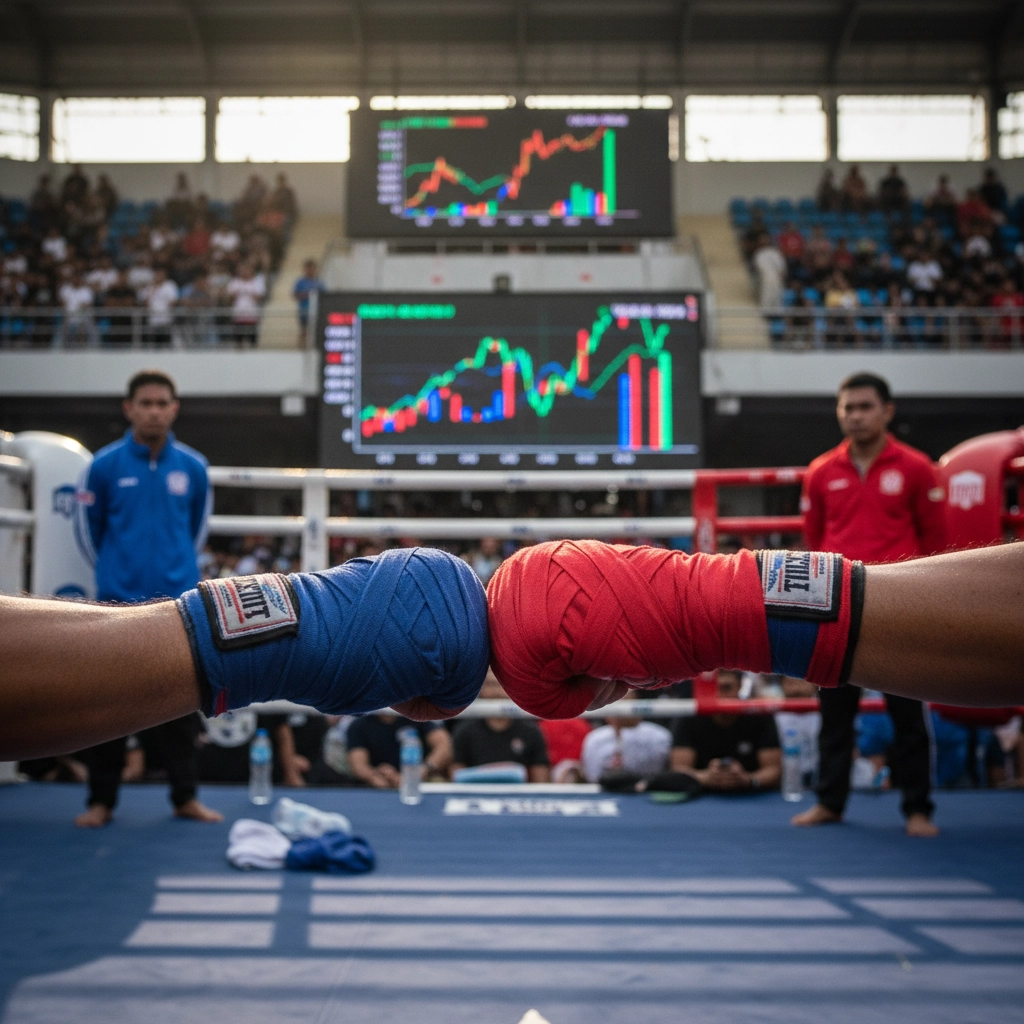
Why reading Muay Thai odds gives you an edge at the ticket window
When you watch a Muay Thai card, the action in the ring is fast, technical, and emotionally charged—and the betting lines move just as quickly. If you want to turn that excitement into consistent profit, you need to read the odds, not the highlight reels. Odds are your language for probability, risk, and value. By learning to interpret them, you’ll avoid common traps like betting on favorites purely because they’re popular or chasing losses after a surprise result.
How odds convert to a betting mindset
Odds do three things for you: they state how much you win, they imply the probability of each outcome, and they reveal how the market values fighters at any given time. Treat each line as a snapshot of market opinion. If your independent assessment of a fighter’s chance is higher than the market’s implied probability, you’ve found value. Conversely, if the market is giving a fighter more credit than you would, the line is overvalued and not worth your stake.
Basic concepts every bettor should master before placing a wager
Before you bet, make sure you understand these building blocks. They will let you translate the numbers you see into an actionable plan:
- Implied probability: Every set of odds corresponds to a percentage chance of an outcome. Learning to convert odds to probability is foundational to comparing your view against the market.
- Value vs. prediction: Betting is not about picking winners 100% of the time; it’s about finding positive expected value (EV). You can lose bets and still make money long-term if the bets you place have better odds than the true probability.
- House edge and vig: Bookmakers charge a commission (the vig or overround). That pushes the summed implied probabilities above 100%—you must overcome this to be profitable.
- Odds formats: Odds can be displayed in American, decimal, or fractional formats. You don’t need to prefer one, but you do need to convert them to implied probability quickly.
Why Muay Thai lines move differently than boxing or MMA
Muay Thai markets have unique quirks. Fighters often have extensive regional records that are underreported internationally, stylistic elements like clinch and elbow skill matter more, and matchups frequently occur with short notice. Those realities make lines more sensitive to specific information:
- Late scratches or small weight differences can swing lines sharply.
- Local favorites and travel issues affect both judging and betting patterns.
- Stylistic matchups (e.g., striker vs. clinch specialist) often change how the public and sharp bettors assess rounds and fight tempo.
Understanding these early concepts sets you up to read the actual numbers with clarity. In the next section you’ll learn how to read the three most common odds formats—American (moneyline), decimal, and fractional—and how to convert each into implied probability so you can spot value in the lines.

Reading the three common odds formats — convert to implied probability
Odds are just different ways to express the same underlying probability. Here are the quick conversions you’ll use at the track or on your phone.
– American (moneyline):
– For negative odds (favorite), implied probability = |odds| / (|odds| + 100). Example: -150 → 150 / (150 + 100) = 0.60 → 60%.
– For positive odds (underdog), implied probability = 100 / (odds + 100). Example: +220 → 100 / (220 + 100) = 0.3125 → 31.25%.
– Decimal:
– Implied probability = 1 / decimal odds. Example: 1.67 → 1 / 1.67 = 0.598 → 59.8%.
– Fractional:
– Convert to decimal first: fractional a/b → decimal = (a/b) + 1. Example: 3/1 → (3/1) + 1 = 4.00 → implied probability = 1 / 4.00 = 25%.
Practice converting mentally: any positive moneyline +X is roughly 100 / (X + 100); any negative moneyline -Y is roughly Y / (Y + 100). Decimal is the simplest for calculations, which is why many pros switch to decimal odds when evaluating value.
Once you can convert quickly, you can compare the market’s implied probability to your own assessment for each fighter. If your assessment is higher than the market’s implied probability after accounting for vig, you’ve potentially found value.
Removing the bookmaker’s edge — calculate true probability and EV
Books add vig, so the summed implied probabilities across all outcomes are usually above 100%. That overround masks the true market view. To estimate the market’s “true” probabilities you need to normalize.
Example: moneyline -150 vs +130.
– Implied probabilities: -150 → 60.0%; +130 → 100 / (130 + 100) = 43.48%.
– Sum = 103.48% (vig ≈ 3.48%).
– Normalized (true) probability for each outcome = implied_prob / sum. So favorite = 60 / 103.48 = 57.98%, underdog = 43.48 / 103.48 = 42.02%.
Now the value check: convert the offered price to decimal odds (e.g., +130 → 2.30). If you estimate the underdog’s true chance at 45%:
– Expected value per $1 = your_prob decimal_odds − 1 = 0.45 2.30 − 1 = 0.035 → $0.035 profit per $1 bet (3.5% ROI).
Positive EV means the wager is profitable on average over the long run. Negative EV means avoid it, no matter how much you like the fighter.
Use this same approach for props and round markets—convert to decimal, normalize if using multiple outcomes, and compare to your independent probability estimate.
Line movement, sharp money, and practical shop‑floor tips
Odds move for a reason. In Muay Thai markets, movement can come from sharp (professional) money, public sentiment, local bias, or late news (weight, travel, medical). Learn to read the signal:
– Sharp movement: sudden, large shifts with low public attention often indicate a professional has placed money. These are worth following or at least noting.
– Public-driven moves: slow drift as casual bettors pile on favorites. These often increase the vig and create value on the other side.
– Late info spikes: monitor weight-ins, camp reports, and social feeds—small details swing Muay Thai lines more than in mainstream sports.
Practical tips: shop multiple books (best line matters), track closing lines (to measure your model), and size your bets according to edge (use a Kelly or flat-percentage variant). For props and live betting, act fast: liquidity is thin and prices can be inefficient but also move instantly.
Arming yourself with fast conversions, normalization for vig, and an eye for market signals will take you from hobby bettor to someone who reads Muay Thai lines like a pro.
- Start small and track every bet: record the line you took, your stake, closing line, and result to measure edge over time.
- Practice converting odds mentally until it’s automatic—decimal conversion is the fastest for EV calculations.
- Compare lines across multiple books before you bet; the best price compounds your edge.
- Monitor camp reports, weigh-ins, and local chatter in the hours leading up to a fight—Muay Thai markets react to small, last-minute info.

Putting odds into action
Now that you can read formats, remove vig, and spot value, treat betting like a repeated experiment: hypothesis (your edge), test (the bet), measurement (results vs. closing line), and iteration (refine your model). Keep discipline on bankroll, size bets to your estimated edge, and prioritize markets where you have informational advantages. For checking live and historical lines across books, a tool like OddsPortal can help you compare prices and track movement quickly.
Frequently Asked Questions
How do I quickly convert American odds to implied probability when I’m watching a card?
Mental shortcuts work: for positive odds (+X), approximate probability as 100 / (X + 100). For negative odds (-Y), use Y / (Y + 100). If you need precision, convert to decimal (positive +X → (X/100)+1; negative -Y → (Y/100)+1) then take 1/decimal. Practice until the common ranges feel intuitive.
What indicates sharp money versus public steam on a Muay Thai line?
Sharp money often causes sudden, sizable moves with little betting volume visible to the public or on fringe markets (e.g., round props shifting quickly). Public steam tends to be slow, steady drift toward favorites and is accompanied by increased betting chatter. Cross-check movement timing, market liquidity, and other books’ responses to infer the source.
Can I reliably find value in live Muay Thai betting, or is pre-fight the better place to wager?
Both have opportunities. Live betting can be inefficient—especially in regional Muay Thai with thin markets—but requires fast decisions and discipline because lines move quickly. Pre-fight markets offer more time to compare books, normalize for vig, and size your bets. Choose the environment that matches your speed, information access, and risk tolerance.
Recommended Posts