Over time, many practitioners fall into habits that hinder their progress and can even lead to injury when executing Muay Thai kicks. This guide outlines key mistakes to avoid, emphasizing the importance of proper technique, balance, and footwork. Awareness of these pitfalls will not only enhance your performance but also ensure a safer training experience, allowing you to harness the full power and effectiveness of each kick. Adopting the right practices will maximize your training and lead to significant improvements in your striking skills.
Types of Muay Thai Kicks
Understanding the various types of Muay Thai kicks is important for effective training. Each kick serves a distinct purpose in both offense and defense. Below are some common types used in practice and competition:
| Roundhouse Kick | A powerful and versatile strike. |
| Teep Kick | An effective push kick for distance management. |
| Side Kick | Aimed at destabilizing an opponent. |
| Back Kick | A surprise attack from a backward position. |
| Knee Strike | An important strike for close-range fighting. |
Any effective practitioner must strive to master these fundamental kicks.
Roundhouse Kick
The Roundhouse Kick is one of the most potent strikes in Muay Thai, targeting the body or head. Executed with the shin, it generates significant power, making it an effective weapon against opponents. Timing and technique are key, as it allows for both offense and defense in a single movement.
Teep Kick
The Teep Kick is often likened to a jab in boxing, used to maintain distance or disrupt an opponent’s rhythm. This kick employs the foot’s sole, targeting the abdomen or chest. It can also prevent attackers from closing the distance, serving as both an offensive and defensive tool.
Incorporating the Teep Kick regularly can significantly improve footwork and distance management. Practitioners often utilize it to gauge distance and set up combinations, allowing for strategic control of the ring. Proper technique involves pushing off the back foot while keeping the body balanced for effective striking.
Side Kick
The Side Kick delivers power while targeting an opponent’s midsection or knee. This kick requires strong hip rotation and proper alignment for maximum impact. Often overlooked, it serves as a great defensive tool by creating space in a clinch or during close-range exchanges.
Utilizing the Side Kick can destabilize an opponent, as it disrupts their balance. Effective practice focuses on using the side of the foot to strike, ensuring the body remains aligned for optimal power. This kick can also serve as a counter against aggressive approaches, providing an unexpected yet effective defensive response.
Back Kick
The Back Kick is a striking technique executed by thrusting the heel back towards an opponent, ideally while pivoting. This kick can deliver surprising power, especially when used from a defensive stance, making it viable for counterattacks.
Practicing the Back Kick enhances awareness of one’s surroundings, enabling fighters to catch opponents off-guard. Key aspects of execution include strong core engagement and proper pivoting to channel force through the kick. This technique can turn the tide of a fight when used effectively and at the right moment.
Common Mistakes When Practicing Kicks
Practicing kicks in Muay Thai involves various technical elements requiring attention to detail. Avoiding common mistakes can enhance performance and safety. Below are critical areas often overlooked by practitioners, leading to ineffective techniques and potential injury.
Poor Stance and Balance
A strong stance is the foundation of effective kicking. Many fighters neglect their balance, causing instability and reducing power. An appropriate stance includes proper foot positioning, weight distribution, and hip alignment, allowing for confident execution of kicks.
Incorrect Chambering
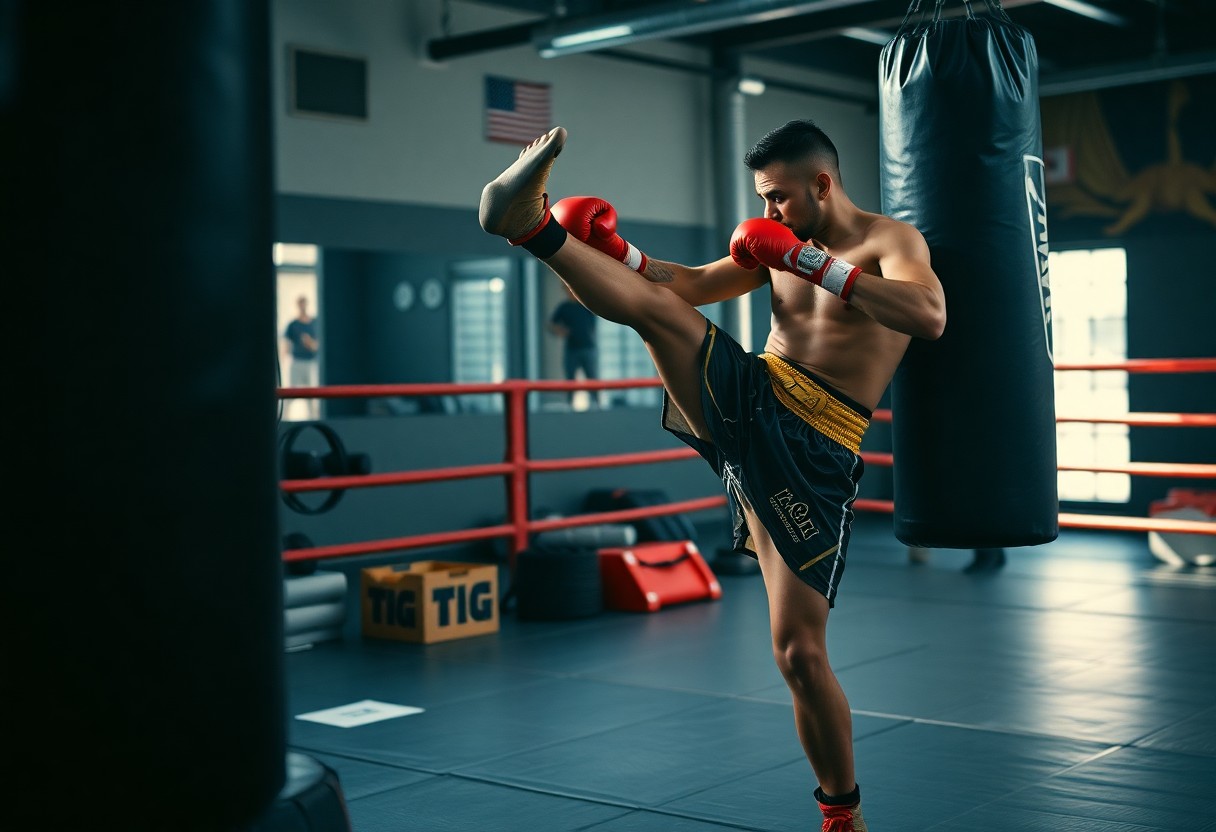
Chambering refers to the position of the leg before executing a kick. Incorrect chambering results in weak kicks and poor follow-through. A proper chamber helps generate power and maintain balance throughout the kick. Each kick should start from a high chamber position to create momentum.
When the knee does not come up high enough during chambering, the kick loses its potency. Practitioners should focus on bringing the knee up in a controlled manner while keeping the supporting leg stable. This positioning not only prepares for a strong follow-through but also prevents overextension, which can lead to balance issues.
Lack of Follow-through
Follow-through is imperative for maximizing the effectiveness of kicks. Skipping this phase often results in a lost opportunity to generate full power and control. Following through ensures that the impact of the kick is absorbed correctly and sets up for the next movement.
Without adequate follow-through, kicks can feel weak and unbalanced. This phase allows the body to transition smoothly into subsequent techniques or defenses. Engaging in drills that emphasize continuous motion can improve this aspect, reinforcing the habit of executing kicks fluidly and powerfully while maintaining balance.
Tips for Improving Kick Technique
Enhancing your kick technique requires diligent practice and attention to detail. Focus on refining your form, dedicating time to slow, deliberate movements, and incorporating shadow boxing into your routine. Here are some important tips:
- Prioritize form during practice.
- Engage in slow practice to build accuracy.
- Utilize shadow boxing for technique improvement.
Thou must approach your training with intention to see tangible improvements.
Focus on Form
Proper form is foundational in executing effective kicks. Ensure that your stance is stable, striking with the correct part of your foot, and keeping your body balanced. Inadequate form can lead to ineffective strikes and increase the risk of injury. Notably, practicing in front of a mirror can help you self-correct and develop an awareness of your body mechanics.
Slow Practice for Accuracy
Practicing kicks slowly allows for greater focus on technique and accuracy. This method ensures that each movement is intentional and correct, rather than rushed. By breaking down the kick into its components, you can identify and correct areas that need improvement, laying a strong foundation for more powerful and effective strikes.
Incorporating slow practice into your routine not only helps refine your techniques but also builds muscle memory. For example, when executing a roundhouse kick, focus on the chambering of your leg, the pivot of your foot, and the follow-through. This method ensures that every element reinforces proper motion, significantly improving your kick over time.
Utilize Shadow Boxing
Shadow boxing is an excellent tool for developing kick technique without the distraction of a partner or equipment. It allows you to visualize your target and integrate footwork, stances, and combinations effectively. This practice encourages fluidity in your movements while allowing you to focus solely on the mechanics of your kicks.
By engaging in shadow boxing, you can recreate a fight scenario while working on kick precision and technique. This can build confidence and adaptability, as you simulate various opponents and distances. Over time, this method helps eliminate bad habits, reinforcing proper posture and execution, making your kicks more fluid and accurate in real sparring situations.
Step-by-Step Guide to Mastering Kicks
| Step | Description |
| Starting Position | Stand in a proper stance with your feet shoulder-width apart, knees slightly bent, and weight evenly distributed. |
| Execution of the Kick | Rotate your hips, pivot your standing foot, and extend your kicking leg to deliver a powerful strike. |
| Recovery and Reset | Quickly retract your kicking leg, returning to your guard position to maintain balance and readiness. |
Starting Position
Achieve the right stance by placing your feet shoulder-width apart. Your knees should be slightly bent to ensure flexibility and enable swift movement. Keep your hands up for protection, with elbows close to your body, ready to guard against incoming strikes.
Execution of the Kick
Initiate the kick by rotating your hips and pivoting on your supporting foot. As you propel your kicking leg forward, use your core for added strength and balance. Aim for a sharp, controlled strike, ensuring your foot connects at the optimal angle for maximum impact.
Focus on using your hip motion as the foundation for power. As your leg extends, snap your knee and flex your ankle to connect with the target using the appropriate surface of your foot. Practicing this motion repetitively will help solidify muscle memory, allowing your kicks to become both powerful and precise.
Recovery and Reset
After executing the kick, it’s vital to retract your leg quickly to regain balance. Bring your leg back into position while returning your hands to the guard stance. This movement should be fluid, allowing you to create opportunities for follow-up strikes or defense.
Prompt recovery is necessary to maintain readiness for the next action. Avoid lingering in an unstable position after kicking; instead, practice transitioning back into your initial stance efficiently. This habit not only preserves your balance but also enhances your overall flow during sparring or competition, making you a more effective fighter.
Factors Influencing Kick Performance
Several key factors significantly affect the performance of your kicks in Muay Thai. These include flexibility, strength and conditioning, timing, and distance. Improving these aspects will enhance your kicking ability and overall effectiveness in the ring. This is necessary for both technique and power.
Flexibility
Flexibility plays a vital role in executing high, powerful kicks. Increased flexibility allows for a greater range of motion, reducing the risk of injury and improving your kick’s height and speed. Incorporating regular stretching routines, especially for the hips and legs, can significantly enhance your overall kicking performance.
Strength and Conditioning
Strength and conditioning are fundamental for powerful kicks. Building leg and core strength can enhance both the speed and impact of your strikes. Strength training that includes squats and lunges can improve your kicking power effectively.
Engaging in a well-rounded strength and conditioning regimen is vital. This should include resistance training, plyometrics, and agility drills to enhance muscle power and coordination. Power output during kicks can be amplified through exercises like box jumps, kettlebell swings, and resistance bands. Building endurance is also necessary to maintain performance throughout training sessions and fights.
Timing and Distance
Proper timing and distance control are necessary for successful kicks. Understanding and gauging your opponent’s movements can help to anticipate the right moment to execute a kick effectively. Mastering timing ensures that your kicks land precisely when your target is exposed.
Timing and distance significantly impact your kick’s effectiveness. Failing to gauge these can lead to missed targets or counterattacks. Practicing footwork drills and shadowboxing can help fine-tune your ability to move in and out of range, making you a more elusive target while delivering powerful strikes. Engaging sparring partners to simulate real fighting scenarios aids in developing a natural sense of timing and distance as well.
Pros and Cons of Different Kick Types
| Kick Type | Pros | Cons |
|---|---|---|
| Roundhouse Kick | Powerful, versatile targeting | Requires hip flexibility |
| Teep Kick | Excellent for keeping distance | Less damage than other kicks |
| Side Kick | High impact, good for mobility | Requires precise timing |
| Hook Kick | Surprise technique, difficult to counter | Less stable footing |
| Back Kick | Powerful and effective | Can leave one open to counters |
Advantages of Roundhouse and Teep Kicks
Roundhouse kicks deliver significant power and impact, making them ideal for offensive strategies. Their versatility allows practitioners to target various levels of the opponent, from head to body. In contrast, teep kicks are excellent for maintaining distance, providing an effective way to control the pace of the fight while minimizing risks of counter-attacks. Both kicks, when utilized correctly, can create openings and set up follow-up strikes.
Limitations of Kicks in Various Situations
Kicks may become less effective in close-range combat or against skilled grapplers. In clinch situations, they can be difficult to execute due to restricted movement. Additionally, terrain and stance play a critical role; uneven surfaces can compromise balance, while poor foot positioning may result in injuries. Recognizing these limitations helps fighters adapt their strategies, opting for techniques more suited to the given context to ensure efficacy.
In certain scenarios, such as when an opponent is relentless in their forward pressure, executing kicks may leave you vulnerable. For example, in a clinch or when grappling, attempting to kick can disrupt your balance and expose you to counter-attacks. Moreover, if the opponent is adept at catching kicks, it can lead to a dangerous position. Tailoring your striking to the specifics of the fight, including distance, speed, and opponent style, is vital for maintaining effectiveness and safety in your technique.
Conclusion
With these considerations in mind, avoiding common mistakes in Muay Thai kick practice is vital for effective skill development. Focusing on proper technique, maintaining balance, and ensuring adequate warm-ups can significantly enhance performance and reduce injury risk. Consistent self-evaluation and seeking feedback from experienced practitioners will further refine your technique, making your training more effective. Prioritizing these aspects will lead to more proficient and powerful kicks, ultimately elevating your overall Muay Thai practice.
FAQ
Q: What is the most common mistake beginners make when practicing Muay Thai kicks?
A: Many beginners neglect proper stance and balance. A stable base is vital for executing effective kicks. Without maintaining the correct stance, kicks can become weak and lack power, leading to injury and ineffective striking.
Q: How does poor hip rotation affect Muay Thai kicks?
A: Insufficient hip rotation significantly impacts the power and technique of kicks. Proper hip movement generates force and allows for natural follow-through. Failing to rotate the hips can result in less impactful strikes and increased risk of injury due to improper mechanics.
Q: Why is it important to focus on accuracy when practicing kicks?
A: Accuracy is vital for effective striking in Muay Thai. Many practitioners focus solely on power and neglect targeting. This can lead to missed opportunities in a match and ineffective training. Practicing with precision ensures that strikes land where intended, maximizing the effectiveness of each kick.
Recommended Posts