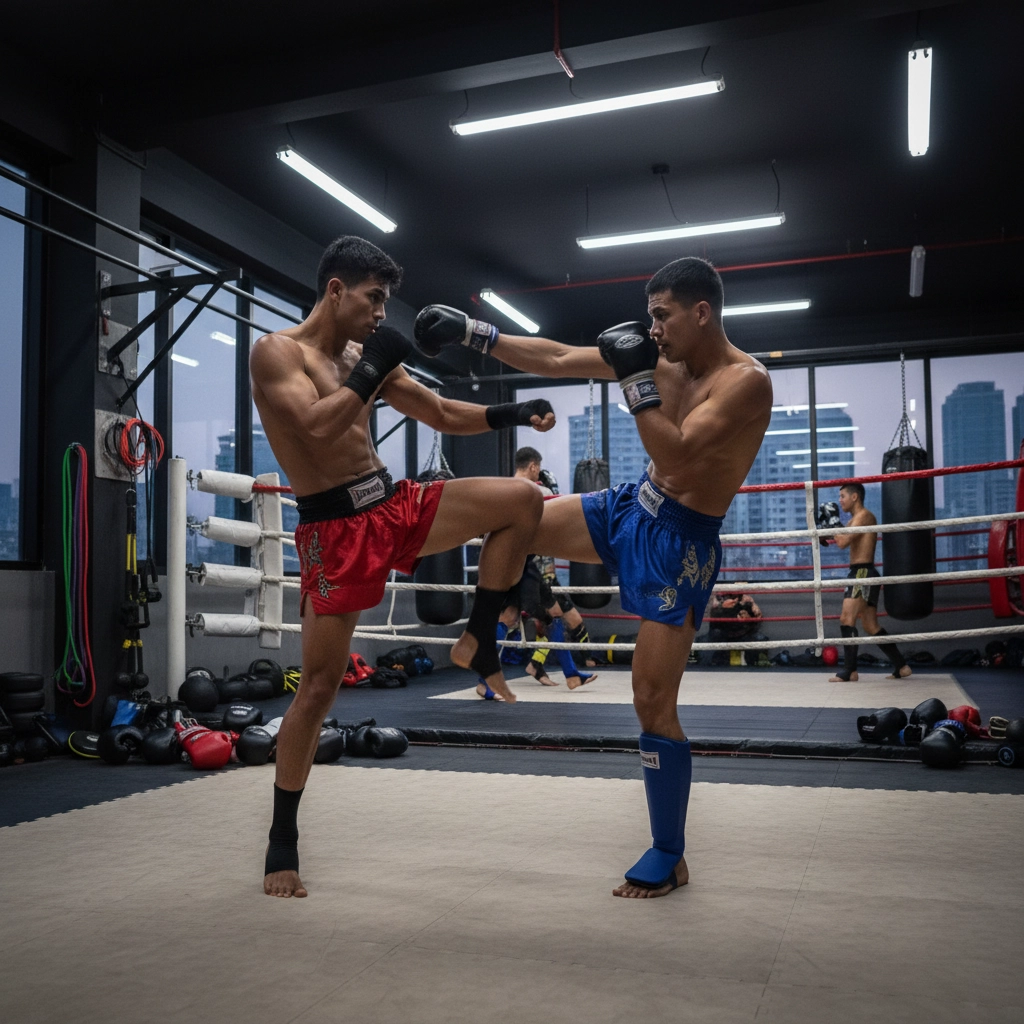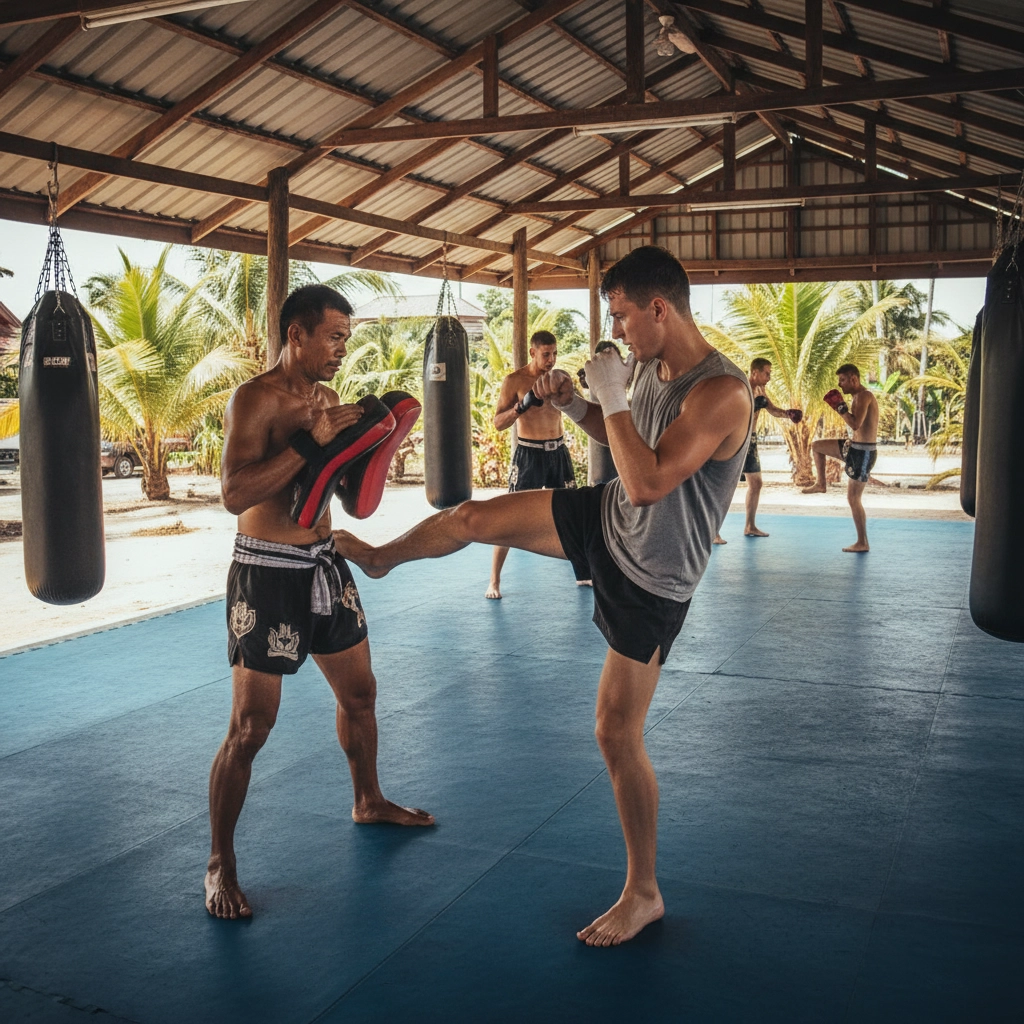

You develop a layered Muay Thai defense by mastering footwork and balance, the fundamentals that let you evade heavy strikes, dictate range, and create precise counterattack openings; efficient movement improves stability under pressure and lowers injury risk, turning defense into a proactive tool rather than passive survival.
Types of Footwork in Muay Thai
Linear and lateral patterns dominate ring control, shifting range in measured increments-typically 1-3 steps for entries and exits within a 2-3 meter window. Linear footwork forces teep and clinch opportunities, while circular motion opens angles for elbows and counters. World-class practitioners like Saenchai use pivots of 45-90° to reduce the opponent’s front-facing options. Recognizing which pattern to apply mid-exchange separates passive shuffling from decisive defensive positioning.
- Linear Movement
- Circular Movement
- Lateral Movement
- Pivoting
- Diagonal Cuts
| Linear | Direct in/out, 1-3 steps, used for teeps, jabs, clinch entries |
| Circular | Angling and pivots, 45-90° turns, creates countering lines |
| Lateral | Side-to-side movement, 2-4 steps, controls ring and avoids low kicks |
| Pivot | On ball of foot, 90° pivots to evade and set hard counters |
| Diagonal | Combines linear + circular to cut off opponents and funnel them to the ropes |
Linear Movement
Short, explosive one-to-three-step advances and retreats define linear movement. Fighters use it to close range for teeps, jab entries and clinch chains, often within 2 meters; poor timing exposes the lead leg to low kicks, so maintain a slightly rear-weighted stance (about 60/40) to mitigate risk. Drill with partner pad sequences of 3-5 repetitions to ingrain timing and recovery.
Circular Movement
Angular footwork uses pivots, arcs and small circling steps to create attack angles; a well-timed 90° pivot can turn a straight target into a flank, opening elbow and diagonal knee opportunities. Elite stylists like Saenchai tie these pivots to immediate counters, typically using 2-4 small steps to manipulate distance while avoiding linear pressure.
Practice specifics: do figure‑8 shadow drills for 3 minutes, then 5 rounds of partner-driven pivot counters-plant the lead foot, pivot on the ball, and snap the hips into the counter. Focus on weight transfer and hip rotation to convert evasive movement into power without telegraphing, and quantify progress by increasing clean pivots per round from 10 to 30 over weeks.
Essential Balance Techniques
Small micro-adjustments between feet control momentum and determine whether you can absorb strikes or immediately counter; train them with timed drills like single-leg holds (30-60s, 3 sets), narrow-stance hops, and slow shadowboxing focusing on weight shifts of 5-10% per step. Use video to measure recovery time-aim to re-center within 0.4-0.6 seconds after an evasive move to maintain ring control and reduce exposure to counters.
Stance and Distribution
Shift weight subtly: many fighters favor a 55/45 rear/lead split for power while dropping to 50/50 when defending low kicks or clinching; keep feet roughly shoulder-width to 1.2x shoulder width to balance stability and mobility. For example, when anticipating a leg kick, move the rear hip back 2-4 cm and bend both knees 10-15°, which shortens reaction time and reduces torque on the planted leg.
Recovery and Adjustment
After an evasion or blocked strike, prioritize a two-step recovery: re-center your weight and re-establish stance width within 0.4-0.6s, then reposition angle by 15-30° to create openings; failing to do so leaves a 0.5-0.8s vulnerability where opponents land counters. Train the timing with intervaled partner drills-poke, withdraw, recover-over 3-minute rounds.
Drill specifics speed adaptation: run a 3-step recovery drill-partner jabs, you slip, perform a single explosive step to regain balance, then rotate 20° and throw a light counter within 600ms. Add resistance bands to simulate force and use cones at 1m spacing for lateral recovery work; track improvement by timing successful recoveries per round, aiming to increase successful recoveries by 30% over 4 weeks.
Tips for Improving Footwork
Practice short, focused sessions-10 minutes of ladder work, 3 rounds of 2-minute cone drills, and 30-second single-leg holds per side to ingrain timing and reinforce footwork and balance; emphasize 1-3 step entries and 45° exit angles to create counter opportunities and off-balance opponents. Film drills to correct heel drag and stance width in live rounds. Thou should prioritize slow, deliberate repetitions to make adjustments automatic.
- Footwork ladder: 10-15 minutes/day for cadence
- Cone zig-zags: 3 rounds × 2 minutes to train 45° pivots
- Single-leg holds & wobble board: 30s × 3 for balance
- Video review: log 3 common errors per session in Muay Thai
Drills and Exercises
Integrate ladder drills for quick feet, cone patterns for sharp pivots, and single-leg balance holds (30s × 3) to stabilize weight transfer; add partner mirror drills-3 rounds of 2 minutes-forcing reactive foot placement. Include plyometric sets (5 × 8 lateral hops) to build explosive lateral push-off important for effective footwork in Muay Thai.
Sparring Application
During controlled sparring dedicate 3 rounds to movement-only: limit offense to counters, practice 2-3 step cut-offs to trap opponents on the ropes, and use lateral angling to break rhythm; measure success by counting clean exits and angle changes per round to quantify improvement and reduce heel drag.
Progress with specific targets-aim for 6 clean angle changes and fewer than 2 stance losses per round-then review footage to correct timing errors. Drill scenarios like opponent entry, clinch escape with a 2-step pivot, and counter-teep timing at 0.4-0.6s after feint to reinforce balance, positional control, and high-percentage Muay Thai defensive responses.
Step-by-Step Guide to Effective Defense
Progress through a short, repeatable sequence: reset stance, lateral shuffle, pivot, clinch exit, and immediate counter; perform each for 60 seconds across 3 rounds. Prioritize staying on the balls of your feet, avoid crossing the feet, and keep the centerline protected. Use progressive overload-add speed or resistance only after balance is flawless-to embed defensive habits under pressure.
| Daily Defensive Drill: Step | |
| Step 1 | Reset stance: 10 reps of stance check + light shadow pivots to re-center weight and guard. |
| Step 2 | Lateral shuffle: 3 sets of 30s each side, keep hips square, avoid crossing feet to maintain balance. |
| Step 3 | 45° pivots: 3×10 reps each direction, finish with a jab to punish the angle change. |
| Step 4 | Clinch exit: hand-fight 20s, step out laterally, re-establish base; practice 5 times per round. |
| Step 5 | Counter drill: immediate teep or jab after escape; 2 minutes continuous, focus on timing not power. |
Incorporating Footwork and Balance
Integrate footwork via specific drills: ladder work for quick 30-60s bursts, cone pivots (10 reps each way) for angle creation, and shadowboxing 3 rounds of 3 minutes while exaggerating weight shifts. Emphasize light heels, knees soft, and a stable 50/50 to 60/40 weight distribution so counters land from a balanced base under fatigue.
Timing and Anticipation
Train timing by isolating cues: run 5-minute rounds on the double-end bag to read rhythm, and perform partner drills where you defend-only for 2 rounds to force prediction. Coaches often use 3×3-minute pattern drills-feed 10 strikes with deliberate telegraphs-to teach reading the opponent’s setup and converting anticipation into a decisive defensive action.
Delve deeper by cataloguing opponent tells: shoulder dip before a hook, hip rotation before a roundhouse, and breath exhale before a long strike. Practice reactive sparring with random-feeding pads (sets of 5 minutes) to shrink reaction windows; be aware that overcommitting a counter can expose you to knees or clinch traps, so train small, controlled responses first, then scale up speed and commitment.
Factors Influencing Defense Mechanisms
- Footwork – angle creation, entry/exit speed
- Balance – stance width, weight distribution
- Timing – trigger recognition and counter windows
- Distance management – 1-3 step control of range
- Body mechanics – hips, knees, center of mass
- Opponent’s style – pressure, counter, or switch fighters
- Reaction time – milliseconds separate blocks from hits
Multiple variables directly alter defensive choices: tight footwork creates angles, stable balance lets you absorb or redirect force, and precise timing converts defense into counters; elite fighters often operate within a 1-2 meter window and use 1-3 step entries to bait weight shifts. After focusing drills on range, weight split, and millisecond reaction cues, layer specific counters tied to each variable.
Body Mechanics
Efficient defense centers on a low, mobile posture-roughly a 60/40 weight split favoring the rear foot for recoil control-and hip rotation of 20-40° to redirect strikes; keeping knees slightly flexed (about 15-25°) lowers your center of mass and improves stability against leg sweeps while enabling quicker pivots and explosive counters.
Opponent’s Style
Adapting to a pressure fighter requires tighter lateral steps and frequent pivots, while a counter-heavy opponent demands feints and rhythm changes; versus southpaws, prioritize outside foot position to protect the temple and mitigate the left-cross threat, and versus switch-stance fighters focus on universal cues like hip alignment rather than stance alone.
Against a Muay Khao clincher, emphasize lateral movement, maintain an outside lead foot, and use quick double-teeps to break posture; when facing a kick-heavy opponent target lower-weight shifts to catch teeps and check low kicks with a 45° shin angle, and versus boxers keep your guard high while timing teep-counters to disrupt their punching rhythm for safer counters and sweeps.
Pros and Cons of Different Footwork Styles
Pros and Cons by Style
| Linear (forward/back) | Pros: Direct entries, strong forward momentum for teeps and power shots. Cons: Predictable patterns; vulnerable to teeps and clinch pressure. |
| Lateral / Side-step | Pros: Creates ~45° angles to neutralize straight attacks and set counters. Cons: Can be trapped on the ropes or over-rotated, losing balance. |
| Pivoting | Pros: Opens 60-90° striking lanes and sudden counter opportunities. Cons: Mis-timed pivots expose the back and ribs to hooks/sweeps. |
| Circling | Pros: Controls ring geography and saps opponent tempo. Cons: Energy-intensive; slow circling invites cornering. |
| Shuffle | Pros: Fast 1-3 step bursts for range management and recovery. Cons: Repetitive shuffles are telegraphed and raise cardio cost over rounds. |
| Switch-step | Pros: Instant stance changes for power and deception. Cons: High balance demand; vulnerable to leg catches or counters if sloppy. |
| Backstep / Retreat | Pros: Creates immediate space for counters and resets. Cons: Invites ring-back pressure and limits offensive options. |
| Clinch-footwork | Pros: Enables sweeps, off-balancing and control at close range. Cons: Very gas-expensive and keeps head in range for strikes. |
| Ring-cutting | Pros: Forces opponent to ropes, ideal for finishes and bodywork. Cons: Requires sustained pressure and high output; risky if opponent escapes. |
| Feint-based movement | Pros: Manipulates timing and opens counters without heavy commitment. Cons: Overuse reduces effectiveness and can be countered. |
Advantages
Combining styles lets you exploit specific windows: lateral steps create ~45° angles to avoid jabs, pivots open 60-90° lanes for counters, and shuffles deliver 1-3 step bursts to close or escape. In drills, alternating 2-minute pivot-shuffle rounds increases successful counter entries; for example, switching from a lateral step into a rear-leg roundhouse often raises clean-contact rates in sparring. Key benefit: superior positioning and clearer counter opportunities.
Disadvantages
Each style carries trade-offs: linear movement invites teeps, pivots mis-timed expose your back, and heavy shuffling raises energy expenditure across three-round fights. Coaches note a 15-25% uptick in opponent counters when a fighter repeats the same pattern, making predictability a major vulnerability. Danger: telegraphing and exposure during committed steps.
Practical mitigation matters: a pivot that opens 60-90° without head realignment can leave ribs and the rear leg open to hooks or sweeps; similarly, an aggressive lateral step taken with weight on the wrong foot risks loss of balance on low-kick contact. Implement drills like timed pivot-to-shield, 1-2 step shuffle into clinch exits, and measure rebound time-typical re-balance after a committed feint is often 0.3-0.8 seconds-so you can reduce those windows and limit exploitability. Focus on posture, weight distribution, and incremental integration of new patterns.
Final Words
Ultimately footwork and balance form the defensive backbone of Muay Thai, enabling fighters to evade, counter, and maintain position while minimizing damage. Developing precise steps, weight distribution, and posture enhances timing, range control, and recovery between exchanges, turning defensive maneuvers into offensive opportunities and long-term ring intelligence.
FAQ
Q: What role do footwork and balance play in Muay Thai defense?
A: Footwork and balance form the foundation of effective defense by managing distance, angles, and timing so you avoid strikes and create counter opportunities. Good balance lets you absorb or redirect force without losing structure; proper foot placement (shoulder-width base, slight bend in knees, weight distributed 50/50 or slightly rear-heavy when retreating) keeps your center of gravity over your base for rapid pivots and checks. Footwork patterns – short shuffles, pivots, diagonal steps and circling – allow you to cut off an attacker’s line, slip outside attacks, and reposition to counters. Efficient footwork reduces energy wasted on recovery and keeps your hands in guard while you move; combined with head and hip alignment it minimizes openings and improves reaction time.
Q: What specific drills improve footwork and balance for defensive use?
A: Effective drills include: shadowboxing focused on movement cadence (slow to fast, emphasize compact recovery), ladder or cone drills for quick directional changes, pivot drills (spin on ball of lead foot then recover guard), circle-step with a partner (maintain distance while circling), single-leg balance holds and controlled hops to build ankle stability, and partner push-recover to train regaining structure under force. Add skipping rope for rhythm and light-on-toes timing. Progress by increasing speed, introducing strikes and counters, then applying in controlled sparring. Typical sets: 3-5 rounds of 3 minutes per drill, or 2-4 sets of 30-60 seconds for explosive footwork exercises; focus on quality of movement and immediate return to guard.
Q: What common mistakes sabotage footwork and balance, and how do I correct them?
A: Common errors include over-stepping or crossing feet, standing too upright or locking knees, looking down, telegraphing direction with shoulders, and failing to recover the guard after movement. Corrective actions: use slow-motion shadowboxing to engrain proper step size and return-to-guard, practice drills in front of a mirror for posture and head position, employ metronome-paced stepping to control cadence, and do balance-board or single-leg stability work for ankle and hip control. Cue fixes: keep knees slightly bent, stay light on the balls of your feet, maintain hips over feet, take short angled steps rather than large linear ones, and always reset hands to guard within one beat after moving. Integrate corrections into partner drills and low-intensity sparring until they become automatic.
Recommended Posts