
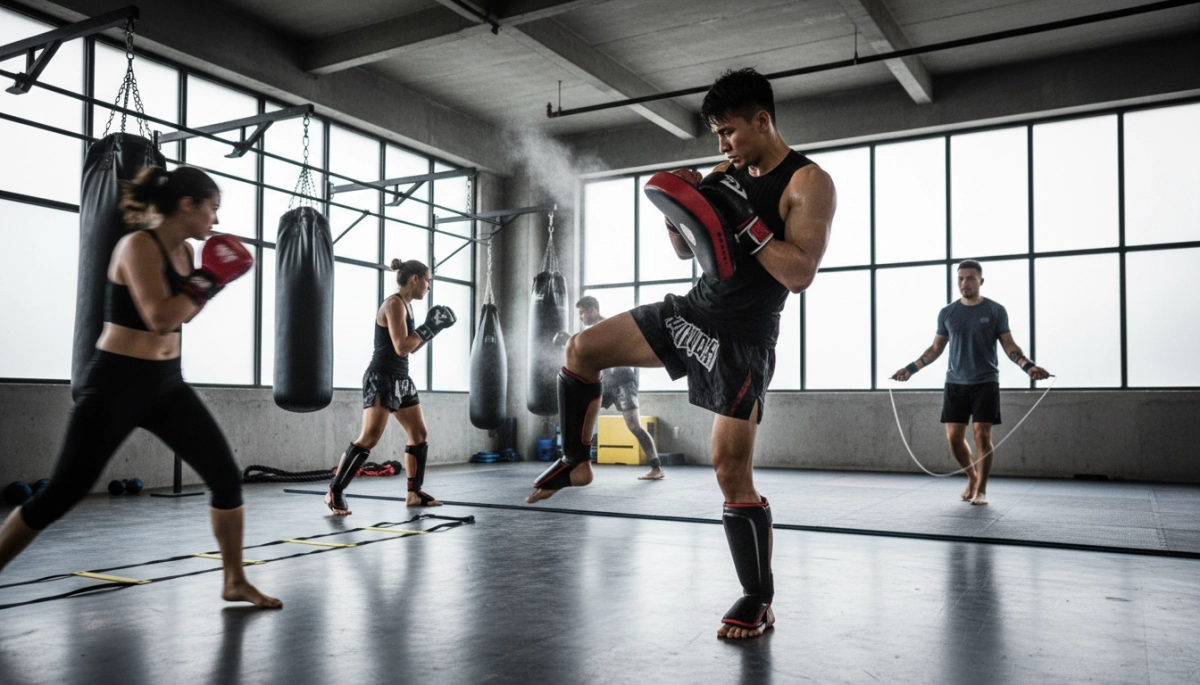
Why power and speed are the competitive edge in modern Muay Thai
You already know Muay Thai is more than brute force or flashy combinations—it’s timing, efficiency, and the ability to deliver decisive strikes under pressure. In modern competition, athletes who pair technical skill with optimized power and speed win exchanges, control distance, and score knockouts. This section explains the physiological and tactical reasons you should prioritize targeted training so every punch, teep, and roundhouse carries more intent and arrives quicker.
How power and speed interact in fights
Power is the product of force and mass delivered over time; speed reduces that delivery time. When you increase the rate at which your muscles can produce force (rate of force development), you create strikes that are both hard and fast. You should focus not only on peak strength but on how rapidly you can express it in fight-like ranges and angles.
Practical benefits you’ll notice
- Cleaner counters: faster reactions let you intercept attacks before opponents reset.
- Improved clinch entries: explosive setups create off-balancing opportunities.
- More efficient energy use: speed and timing reduce wasted movement across rounds.
Foundational elements to build fast, powerful strikes
Before you load heavy striking sessions, you must build movement quality and neuromuscular efficiency. Skipping these foundations often leads to wasted effort or injury. The next subsections outline the core building blocks you should integrate into weekly training.
Movement mechanics and technique refinement
Power starts with structure and technique. You should drill hip rotation, weight transfer, and footwork at submaximal speed to engrain biomechanically efficient patterns. Use slow-motion and tempo work to feel how your kinetic chain transfers from ground to fist or shin, then gradually increase intent while maintaining form.
- Shadowbox with focus: prioritize hip snap and chambering over volume.
- Partner pad work: brief, maximally intent rounds (4–6 reps) emphasize ballistics, not endurance.
- Video feedback: record and correct asymmetries that dissipate force.
Neuromuscular preparation and rate-of-force development
You need to train the nervous system to recruit muscle fibers quickly. Short, high-intent sets and plyometrics teach your body to reach peak force faster than long endurance rounds. Implement contrast training (pairing a heavy strength effort with an explosive movement), medicine-ball throws, and short sprints to improve the rate of force development specific to striking actions.
- Contrast sets: heavy squats or deadlifts followed by explosive jumps or striking drills.
- Plyometrics: single-leg hops, rotational medicine-ball throws to mirror striking planes.
- Short sprints/intervals: preserve speed under fatigue with 10–30 second bursts.
With these foundations in place, you’ll be ready to layer sport-specific power drills, strength cycles, and periodized plans that translate directly to the ring. In the next section you’ll get detailed drills, sample workouts, and how to structure them across a training week.
Sport-specific power drills and progressions
To transfer strength and explosiveness into effective strikes, use drills that mimic the planes and timing of Muay Thai while keeping volume low and intent high. Progress each drill by increasing intent, adding ballistic load, or reducing protective cues until the movement is fight-representative.
– Heavy bag power singles: 6–8 sets of 3–4 maximal-power strikes (roundhouse or teep), 60–90s rest. Focus on full hip rotation and a controlled recovery rather than chaining dozens of strikes. Load progressions: add slight weighted vest or switch to heavier bag once technique stays clean.
– Medicine-ball rotational throws: 3–5 x 6–8 each side. Perform from a split-stance to simulate the hip snap of a roundhouse. Cue explosive initiation from the back leg and follow-through with the shoulders.
– Plyo push-ups and clap variations: 3–5 x 3–6 reps to develop upper-body ballistic power for punches and elbow strikes. Use elevated surfaces or single-arm progressions as strength allows.
– Contrast pairings: pair a heavy compound (3–5 reps @80–90% 1RM) with a ballistic strike drill or jump (6–8 reps). Example: 3 heavy trap-bar deadlifts then 6 explosive broad jumps or 6 medicine-ball slams. Rest 2–3 minutes between pairs.
– Single-leg reactive hops and lateral bounds: 3–4 x 5–6 reps. These build the unilateral explosiveness needed for committed teeps and pivoting kicks.
– Short range speed-power rounds on pads: 4–6 rounds of 20–30 seconds emphasizing single maximal-effort strikes separated by light resets. Pad-holder should return mitts quickly to simulate timing and allow for repeated high-intent reps without endurance fatigue.
Key execution cues: keep sets short, prioritize maximal intent, and stop when form degrades. Power gains come from quality, not volume.
Weekly structure and sample workouts for power and speed
Organize the week to separate heavy CNS work from high-volume skill sessions and to preserve freshness for technical intensity. Below is a three-day template you can adapt to a 5–6 day schedule by inserting light technique or active recovery days.
Example A — Compact week (3 focused sessions + 2 skill/conditioning days)
– Day 1 — Lower-body power + technical speed
– Warm-up: dynamic hip drills, short sprints
– Contrast: heavy back squats 4×3 @85%, then jump squats 4×6
– Bag singles: 6×3 roundhouse kicks (max intent)
– Skill: 20 min light pad work focusing on speed of combinations
– Day 2 — Skill, conditioning, active recovery
– Technical sparring (low-moderate intensity) 4–6 rounds
– Short intervals: 8×20s all-out sprints with full recovery
– Mobility and soft tissue work
– Day 3 — Upper-body power + ballistic striking
– Plyo push-ups 5×4, medicine-ball rotational throws 4×8/side
– Pad work: 6×20s maximal hand/short-elbow bursts
– Core: anti-rotation holds and explosive carries
– Day 4 — Rest or light technical drilling
– Day 5 — Mixed speed-power session
– Overspeed shadowboxing (light gloves, metronome) 6×90s
– Reactive partner drills: catch-and-counter within 1–2 strikes
– Unilateral hops and footwork ladders
Intensity and recovery rules:
– Power stations: 3–6 sets, 2–5 minutes rest; stop when bar speed or strike intent drops.
– Speed sessions: 4–8 rounds of 20–90s with 1–3 minutes rest to preserve quality.
– Place heavy, CNS-taxing strength or contrast work 48–72 hours away from maximal sparring.
Monitoring progress and avoiding common pitfalls
Track objective and subjective markers: vertical jump, medicine-ball throw distance, bar speed (if available), and session RPE. If jump height or strike power stagnates while fatigue increases, back off volume or add a deload week.
Common mistakes to avoid:
– Overloading technical sessions — power work should not replace deliberate technique practice.
– Excessive volume — too many maximal attempts erode speed and increase injury risk.
– Neglecting unilateral work and mobility — asymmetries reduce force transfer and invite strain.
Aim for steady, measurable increases in explosive outputs while keeping technical quality non-negotiable. This balance ensures improvements show up as faster, harder strikes when it matters most.
Putting it into Practice
Start small: introduce short, high-intent power stations twice weekly while keeping most sessions technical. Prioritize recovery, objective testing (jump height, medicine-ball throws), and coach feedback to ensure gains transfer to the ring. For deeper reading on the physiological principles behind rate-of-force development and how it applies to combat sports, see research on rate of force development.
Key Takeaways
- Train quality over quantity: short, maximal-intent sets yield better power and speed gains than high-volume repetitions.
- Combine neuromuscular, unilateral, and sport-specific ballistic drills with targeted strength work to improve fight-applicable explosiveness.
- Monitor objective metrics and fatigue; progress gradually and protect technical practice to ensure improvements show up in competition.
Recommended Posts
