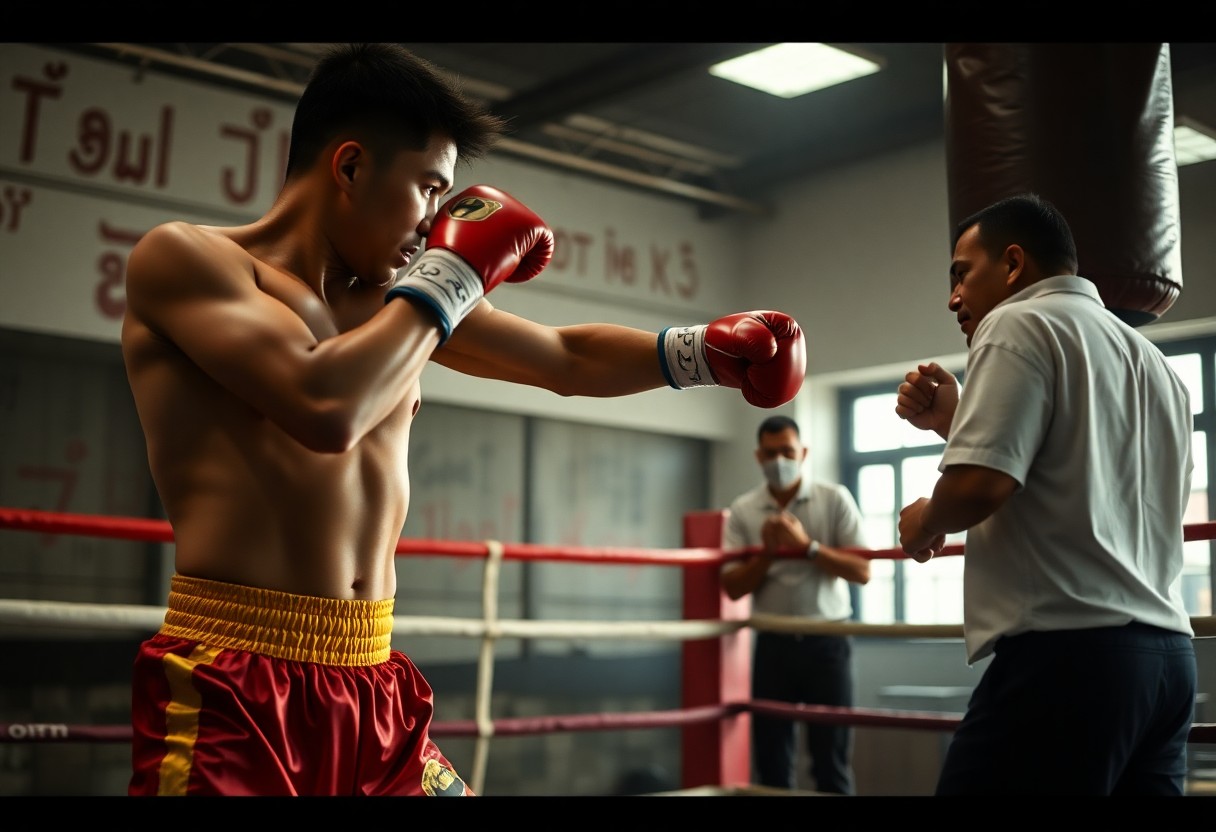
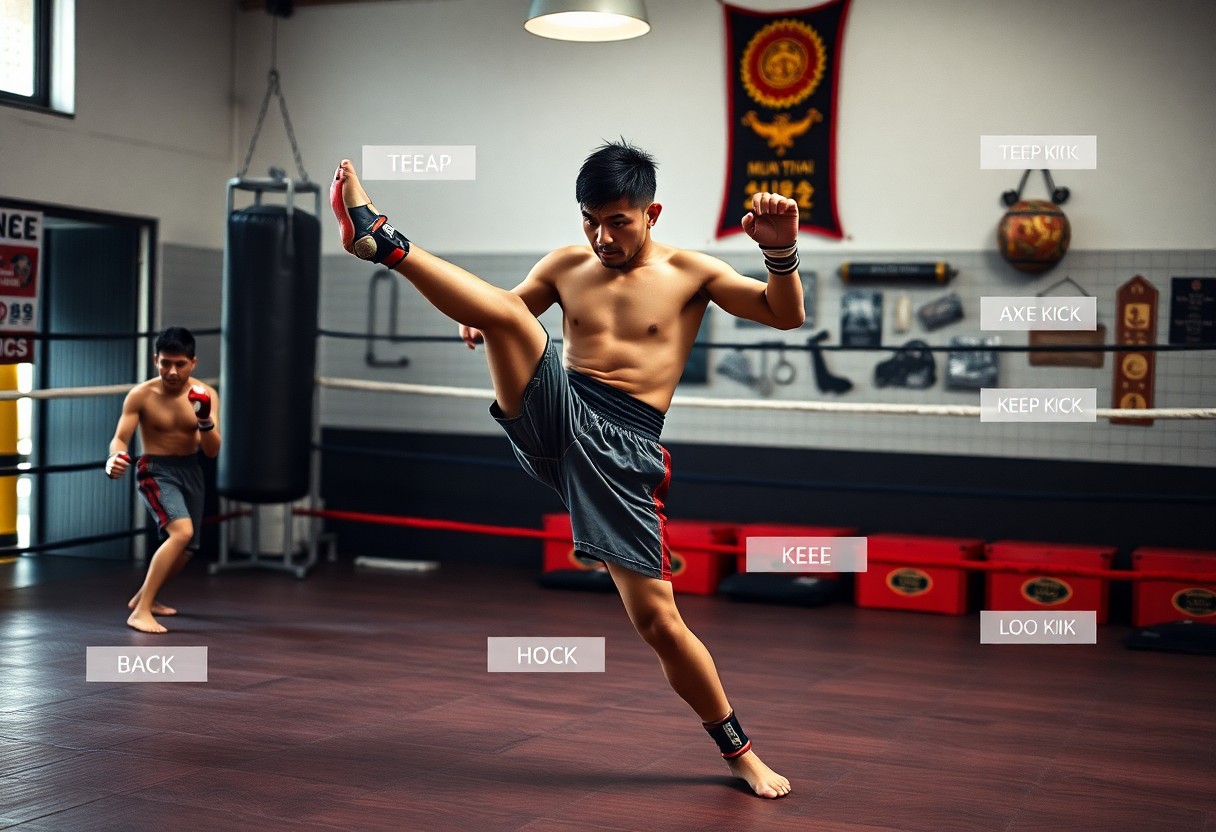
Just mastering the fundamentals of Muay Thai can elevate your fighting skills to new heights. This guide covers eight necessary kicks that every fighter should incorporate into their training regimen. Each kick not only enhances your striking versatility but also improves your overall balance and power in the ring. From devastating roundhouse kicks to sneaky knee strikes, understanding these techniques will give you a distinct advantage over your opponents. Equip yourself with this knowledge to unleash your full potential as a fighter.
Types of Muay Thai Kicks
- Roundhouse Kick
- Teep Kick
- Low Kick
- High Kick
- Switch Kick
The various types of Muay Thai kicks each serve distinct purposes in both offense and defense.
| Kick Type | Description |
| Roundhouse Kick | Powerful, circular kick targeting thighs or head. |
| Teep Kick | Front push kick used for distance and control. |
| Low Kick | Targets opponent’s leg, causing pain and instability. |
| High Kick | Aim for the head with explosive upward momentum. |
| Switch Kick | A quick technique transitioning guards before execution. |
Roundhouse Kick
The roundhouse kick, or “tee” kick, is delivered by swinging the leg in a circular motion, impacting with the shin or foot. It’s primarily aimed at the opponent’s body and head, delivering considerable force and can easily incapacitate an opponent. Mastering timing and angle enhances effectiveness.
Teep Kick
The teep kick is a fundamental push kick predominantly used for maintaining distance. By targeting the opponent’s chest or stomach, it disrupts their rhythm and creates space. This kick is especially effective when used to keep aggressive fighters at bay, allowing for strategic counter-attacks.
This technique is often referred to as the “front kick” and employs a straight leg motion, relying on precision and aim rather than raw power. Its versatility makes it important for controlling the pace of a fight, keeping opponents off-balance and generating openings for further attacks.
Low Kick
The low kick targets an opponent’s thigh, aiming to inflict pain and reduce mobility. Executed with precision, this kick can significantly impair an opponent’s movement, making it easier to land other strikes. It’s commonly used in conjunction with other techniques for maximum effectiveness.
Regularly utilizing the low kick not only accumulates damage but also discourages opponents from advancing or maintaining their stance. A well-placed low kick can hinder their ability to move fluidly, giving fighters a strategic advantage during exchanges.
High Kick
The high kick is a striking maneuver aimed at an opponent’s head, requiring flexibility and explosive power. When timed correctly, this kick can deliver devastating results, often leading to knockouts. It’s vital for fighters to stay balanced while executing this kick to ensure effective follow-ups.
A successful high kick combines technique, momentum, and accuracy. Fighters benefit from practicing this technique against pads and opponents to develop precision. Executing a high kick effectively not only scores points but can also demoralize opponents, showcasing their defensive vulnerabilities.
Step-by-Step Techniques
| Roundhouse Kick | Pivot on your supporting foot, lift your knee to waist level, then extend your leg while rotating your hips for maximum power. |
| Teep Kick | From your stance, shift your weight back slightly, extend your leg straight out, and push from the hip to generate force while keeping your hands up for protection. |
How to Execute a Roundhouse Kick
Initiate the roundhouse kick by pivoting on your lead foot to create rotation. Lift your knee to waist height and, as you extend your leg, make sure to rotate your hips to generate added momentum. Striking with the shin or the foot can increase impact, targeting simultaneously the opponent’s head or body for maximum effectiveness.
How to Execute a Teep Kick
To perform a teep kick, start in your fighting stance. Shift your weight back and extend your leg forward, driving through the ball of your foot while keeping your guard up. Aim to push away an opponent or interrupt their balance with this defensive maneuver, highlighting its utility for maintaining distance.
The teep kick is not only a striking technique but a strategic tool. Used effectively, it can disrupt an opponent’s rhythm and entry, providing you an opportunity to close the distance or counterattack. Its versatility allows for both offensive and defensive plays, making it vital for any fighter looking to control the pace of the match.
Tips for Effective Kicking
To enhance your Muay Thai kicking techniques, focus on the following aspects:
- Proper technique for accurate strikes
- Strong core engagement for added power
- Controlled breathing to maintain stamina
- Footwork to create angles
- Consistency through practice and drill
Any improvements in these areas can significantly elevate your performance in the ring.
Proper Stance and Balance
Your foundation in Muay Thai hinges on a solid stance. Stand with feet shoulder-width apart, ensuring your weight is evenly distributed. A slight bend in your knees enhances stability and readiness for kicks. Maintaining an upright posture allows for effective mobility while keeping your core engaged will provide necessary balance. Always adjust your position based on the distance to your opponent.
Timing and Distance Management
Effective kicking relies heavily on mastering timing and distance. Understanding when to launch your kicks based on your opponent’s movements can create openings for successful strikes. Gauge the distance to ensure your kicks land precisely without overextending. Employing quick footwork aids in closing gaps, while sharp reflexes help capitalize on moments of opportunity.
Timing and distance management is integral to Muay Thai success. Fighters should practice visualizing their opponent’s rhythm, allowing kicks to counterattack or intercept strikes effectively. Utilizing drills that simulate real fight scenarios-like pad work or sparring-can sharpen these skills. Moreover, strategic feints can create distractions, drawing opponents into a position where they become vulnerable to strong, well-timed kicks.
Factors to Consider in Training
When training in Muay Thai, a few key factors can significantly impact your performance. Consider your individual strength and flexibility, as these attributes directly influence your kicking power and range. Additionally, focus on your training environment, including the availability of equipment and access to experienced coaches. Nutrition plays a role in your energy levels, while mental resilience helps overcome training obstacles. Thou must ensure a balanced approach for optimal progress.
Flexibility and Strength
Enhancing your flexibility and strength is critical for executing powerful Muay Thai kicks. Regular stretching improves your range of motion, making it easier to perform high kicks or evade strikes. Strength training, particularly for the core and legs, supports greater power generation during kicks. Incorporating exercises like squats, lunges, and dynamic stretches can lead to improved kicking technique and overall fighting ability.
Impact and Target Zones
Understanding the impact and target zones of your kicks can greatly enhance your effectiveness in the ring. Each kick targets specific areas of the opponent, yielding different results based on accuracy and location. Striking the thigh with a low kick can debilitate an opponent, while aiming for the head can score critical points. Precision in these zones not only maximizes damage but also elevates your overall strategic approach. Thou must train consistently to pinpoint these vital areas for maximum effect.
Expanding on the impact and target zones reveals their significance in achieving victory in Muay Thai. By mastering the designated areas, a fighter can effectively disrupt their opponent’s balance and rhythm. For instance, targeting the knee with a well-placed low kick can severely affect mobility, while a knockout strike to the head can end a match instantly. Additionally, understanding the biomechanics of impact-such as the proper alignment of your body when delivering kicks-ensures optimal force transfer and minimizes the risk of injury. Practicing these aspects during training solidifies a fighter’s ability to execute precise and powerful kicks during competition.
Pros and Cons of Each Kick
| Kick Type | Pros and Cons |
|---|---|
| Roundhouse Kick | High power; Effective for head and body strikes. Vulnerable to counters. |
| Teep Kick | Great for distance control; Can disrupt opponent’s rhythm. Less power in close range. |
| Low Kick | Effective for leg damage; Slows down opponents. Can be hard to land against fast fighters. |
| High Kick | High knockout potential; Visually impressive. Requires flexibility and timing. |
| Switch Kick | Surprises opponents; Transitions well between stances. Risks exposure during the switch. |
| Side Kick | Excellent at maintaining distance; Strong for attacking midsection. Limited follow-up options. |
| Jumping Kick | Visually stunning; Can deliver significant surprise attacks. High risk of landing awkwardly. |
| Crescents Kick | Versatile for attacks and blocks; Great for targeting knees. Less power compared to roundhouse kicks. |
Advantages of Specific Kicks
Each Muay Thai kick offers unique advantages that can be leveraged during a fight. The roundhouse kick delivers immense power, making it formidable when targeting the opponent’s head or ribs. The teep kick is excellent for controlling distance and disrupting an opponent’s forward movement. Low kicks excel in damaging an opponent’s legs over time, while high kicks can lead to knockout opportunities. Kicks like the switch and jumping kick can add unpredictability, enhancing a fighter’s offensive strategy.
Potential Drawbacks and Limitations
Despite their strengths, Muay Thai kicks come with limitations that fighters must navigate. A kick might leave a fighter off-balance, open to counterattacks or make them predictable. For instance, high kicks require significant flexibility and timing, risking clumsy execution. Low kicks can be difficult to land against faster opponents and may leave fighters susceptible to leg checks. Each kick’s effectiveness can also depend on the fighter’s style and the context of the bout.
Moreover, some kicks necessitate precise footwork and timing. A poorly executed roundhouse kick can lead to an easy counter. High kicks, while potent, may expose the fighter to takedowns if mistimed. In fast-paced environments, maintaining the right balance between attack power and defensive readiness is imperative. Fighters should strive to understand not only their strengths but also the circumstances that may hinder their effectiveness during a match.
Common Mistakes to Avoid
Avoiding common mistakes can significantly enhance your Muay Thai performance and effective striking. Each element of your kick plays a critical role in the overall effectiveness and safety of your technique. Here are two specific pitfalls to watch out for during training and practice.
Lack of Follow-through
Failure to follow through on your kicks can diminish both power and precision. This often results in weak strikes that do not connect effectively. Committing to your kick allows for greater impact, ensuring that you generate maximum force while maintaining balance.
Poor Technique
Neglecting proper technique can lead to ineffective strikes and increased risk of injury. Common errors include improper hip rotation, incorrect foot positioning, and insufficient weight transfer. These flaws can hinder performance and prevent you from executing powerful, accurate kicks.
For example, executing a roundhouse kick without proper hip rotation can severely limit the range of motion and power. Overall, maintaining proper alignment and weight transfer is key; the hip drives the kick while the foot should connect at the optimal angle. When training, focus on correcting these technical flaws; consider working with a coach or using video analysis to gain insight. Investing time in mastering your form will yield far greater results in your Muay Thai journey.
Conclusion
Considering all points, mastering the eight important Muay Thai kicks significantly enhances a fighter’s technique and adaptability in the ring. Each kick serves a distinct purpose, contributing not only to offensive strategies but also to defensive maneuvers. Practicing these kicks diligently allows fighters to develop power, precision, and fluidity, important attributes for success. Whether a beginner or an experienced practitioner, incorporating these techniques into training regimens will elevate overall performance and effectiveness in bouts.
FAQ
Q: What are the eight crucial Muay Thai kicks that every fighter should know?
A: The eight crucial Muay Thai kicks include the roundhouse kick, teep (front kick), knee strike, push kick, low kick, axe kick, spinning elbow kick, and high kick. Mastering these kicks is fundamental for effective striking and overall proficiency in Muay Thai.
Q: How can a fighter improve their kicking technique in Muay Thai?
A: A fighter can improve their kicking technique by practicing regularly, focusing on form, using the proper stance, incorporating shadow boxing, and training with a partner or on pads. Additionally, strength and flexibility training will enhance kicking power and range.
Q: What is the importance of timing and distance when executing Muay Thai kicks?
A: Timing and distance are vital in executing Muay Thai kicks effectively. Proper timing allows a fighter to land their kicks at the right moment, while maintaining the correct distance ensures they can strike without being countered. Mastery of these elements contributes to offensive and defensive strategies in fights.
Recommended Posts