
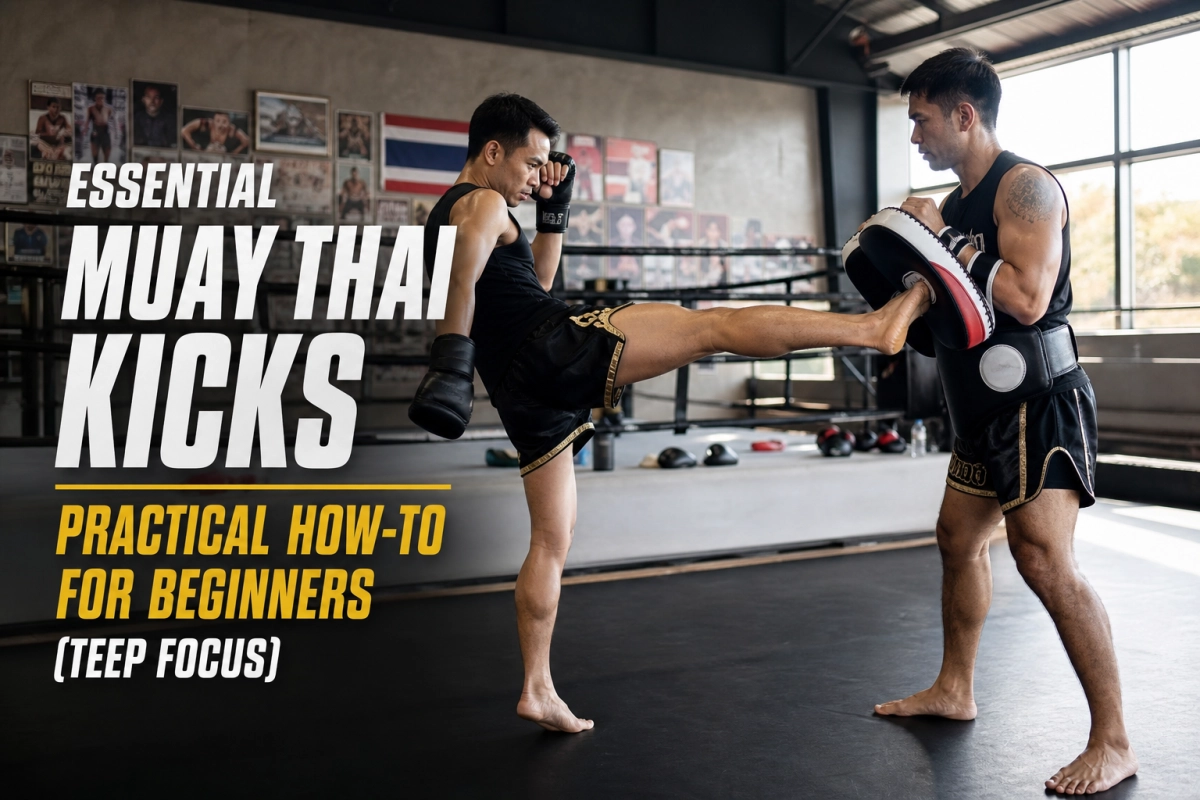
Practical guide to Muay Thai kicks: fundamentals and the teep
Muay Thai kicks are central to the art of eight limbs, combining kicks, punches, elbows, and knees into a complete striking system. This guide is written for Muay Thai beginners and fitness-minded readers who want clear, safe instruction on the most essential kicks. Part 1 establishes core principles—stance, balance, and movement—and then explains the teep (push kick) in depth so readers can begin practicing correctly.
Core standing fundamentals for reliable kicking
Before attempting any kick, the correct Muay Thai stance and body position must be learned. A strong base, compact guard, hip mobility, and proper weight distribution make kicks more powerful, accurate, and defensible.
- Stance basics: Feet shoulder-width apart, lead foot angled slightly inward, weight about 60/40 on the rear foot for mobility. Hands should stay high—rear hand protecting chin and lead hand at nose level—to maintain a Muay Thai guard.
- Hip and pelvis: Kicks come from the hips. Practice rotating the hips independently of the shoulders; this separation adds power while keeping the head protected.
- Balance and posture: Keep a slight bend in both knees, chest upright, and eyes on the target. Tighten the core to resist counters and maintain balance during recoil.
- Movement: Use short, incremental steps rather than large lunges. Light footwork keeps the fighter in range and ready to clinch, jab, or circle away.
The teep (push kick): purpose, stance and mechanics
The teep—often called the push kick—is a fundamental Muay Thai technique used to control distance, off-balance an opponent, set up combinations, and score. It can be delivered with the lead or rear leg and is useful in both defensive and offensive sequences.
Correct stance and body position for the teep
Set in the basic stance described above. The teep starts from a stable weight distribution so the kicking leg can snap forward while the support leg absorbs impact and maintains balance.
- Keep hands high; slightly drop the lead elbow to add forward reach if needed.
- Shift weight to the rear leg just before the kick, keeping the support knee slightly bent.
- Point the toes of the kicking foot back and strike with the ball of the foot (for target zones like the chest) or the heel for longer reach.
Step-by-step execution of a teep
Practice these steps slowly before adding speed and power.
- From stance, chamber the kicking knee forward toward the chest while keeping upright posture.
- Extend the leg forward, pushing through the hip and driving the foot into the target.
- Keep toes flexed (toes toward shin) and ankle locked at impact.
- Immediately retract the leg along the same line and return to stance, ready to follow up or move.
Common beginner mistakes and brief defensive notes
Beginners often lean back or drop the hands while teeping, which invites counters. Common errors and simple defenses are listed below.
- Leaning back reduces power and balance—stay upright and use hip drive.
- Dropping the guard exposes the head—maintain both hands up and tuck the chin.
- Predictable timing makes the teep easy to catch—vary rhythm and mix with feints.
- Defensive consideration: opponents may step in or check a teep—be ready to circle, clinch, or throw punches after a missed teep.
Progressive drills, conditioning tips for effective teeps, and safety precautions for shin and joint health will follow in the next section, which begins with pad work and partner drills for building accuracy and timing.
Progressive pad and partner drills for the teep — conditioning and safety
Once the basic teep is comfortable, structured drilling builds timing, accuracy, and impact tolerance while protecting joints and shins.
Pad and partner drills (progression)
- Light target teep: Partner holds Thai pads at chest height. Practice 5–10 controlled teeps per set, focusing on straight line and quick recoil.
- Range management drill: Partner moves forward/back; attacker uses teep to control distance—work 30–60 seconds rounds, emphasizing foot placement and weight shift.
- Teep + follow-up: Teep to create space, immediately follow with a jab or step-in low kick. This builds transitional timing and reduces predictability.
- Catching and countering: Partner catches a light teep; attacker practices immediate recovery—pivot, clinch, or throw a quick combination. Start slow to avoid injury.
Conditioning and strengthening
- Single-leg balance drills: 30–60 seconds per leg on a flat surface, progressing to unstable surfaces to improve support-leg stability.
- Hip mobility and band work: Lateral band walks and resisted leg drives to strengthen hip abductors and adductors for snap and retraction.
- Calf and ankle conditioning: Controlled heel raises and dorsiflexion exercises to stabilize the ankle at impact.
- Progressive shin conditioning: Only after months of technique work; use light shin taps on heavy bag increasing intensity gradually. Avoid excessive banging early on.
Safety precautions
- Warm up hips, knees, and ankles thoroughly before drilling.
- Use proper targets—Thai pads or heavy bags—never hard surfaces for teeps.
- Communicate with partners about intensity; start slow and increase power incrementally.
- Stop if you feel joint pain; soreness is normal, sharp pain is not.
Roundhouse and low (leg) kick: mechanics, drills, and protective tips
The roundhouse (mid/high) and low kick (to the thigh) are primary offensive weapons in Muay Thai. Their shared mechanics (hip rotation and pivoting) make it efficient to learn them together while respecting their distinct targets and defenses.
Purpose and stance
- Roundhouse: damage body/head, break guard, set up combinations.
- Low kick: disrupt opponent’s base, reduce mobility, open up higher targets.
- Stance: same base as before; chamber knee across the body while rotating hips and pivoting the support foot for power.
Step-by-step execution
- Chamber the knee toward the opposite shoulder (roundhouse) or slightly lower for a low kick.
- Rotate the hips explosively and pivot the support foot so toes point away; extend the leg, striking with the shin.
- Snap or drive through depending on target—snap for head/body, driving rotation into thigh for low kicks.
- Retract quickly and reset guard—avoid over-committing.
Common mistakes and defenses
- Telegraphing—drops hip too early or shifts weight forward; keep rhythm varied and use feints.
- Poor pivot reduces power and risks knee strain—practice foot rotation slowly until natural.
- Defensive considerations: opponents will check low kicks with a lifted shin or step out—mix speeds and targets, and be ready to follow a checked kick with a teep or punch combination.
Progressive drills and conditioning
- Shadow roundhouses focusing on hip rotation and pivot cadence.
- Partner pad sequences: single-shin strikes at increasing power, then chains (low then body).
- Heavy bag rounds: 3-minute intervals alternating snap and power reps; finish with slow, focused technique swings.
- Conditioning: eccentric hamstring work, hip rotational medicine-ball throws, and graded shin conditioning on the bag—avoid hard impacts until form is solid.
Next steps and training habits to keep improving
Learning Muay Thai kicks is a long-term process of small, consistent improvements. Prioritize steady, deliberate practice over short bursts of intensity. Stay patient with technique, protect your body, and cultivate habits that make progress sustainable: regular coaching feedback, deliberate drilling, and measured conditioning. Progress will follow when you respect recovery, maintain curiosity, and train with intent.
Practical habits to adopt
- Train with a purpose each session—set one technical goal (e.g., cleaner pivot) and one conditioning goal (e.g., single-leg balance).
- Record technique occasionally to spot faults you can’t feel in the moment; review with a coach when possible.
- Increase intensity gradually: build reps and impact over weeks and months, not days.
- Prioritize joint and soft-tissue care—mobility work, targeted strength, and proper warm-ups before kicking.
- Use sparring and controlled partner drills to test timing and defenses, keeping contact levels appropriate for your experience.
- Respect training partners and communicate about intensity and goals to reduce injury risk and create better learning environments.
Final encouragement
Mastery of the teep, roundhouse, low kick, switch and body kicks comes from repetition, attention to detail, and thoughtful conditioning. Keep the fundamentals at the center of your training, listen to your body, and celebrate incremental gains. With consistent work and smart practice habits, your kicks will become more powerful, reliable, and effective—both in sport and for fitness.
Recommended Posts
