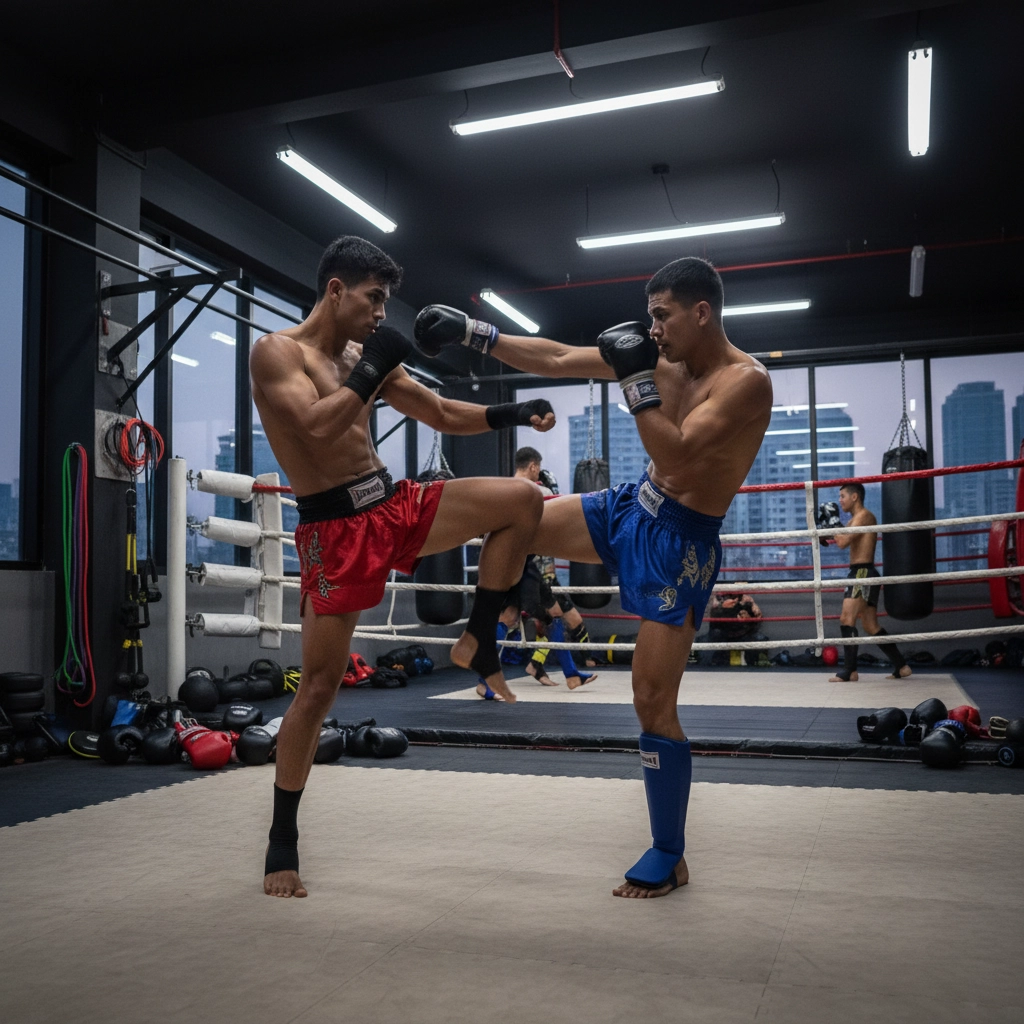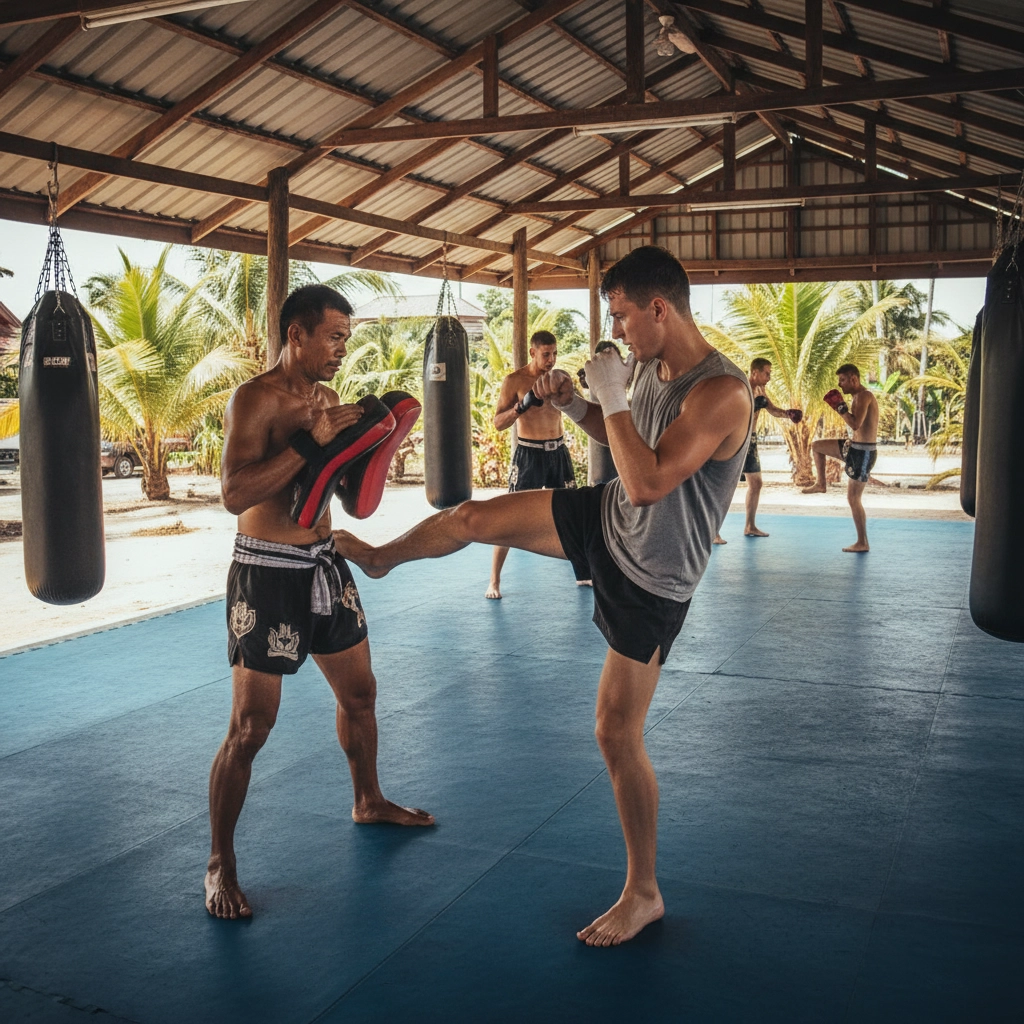
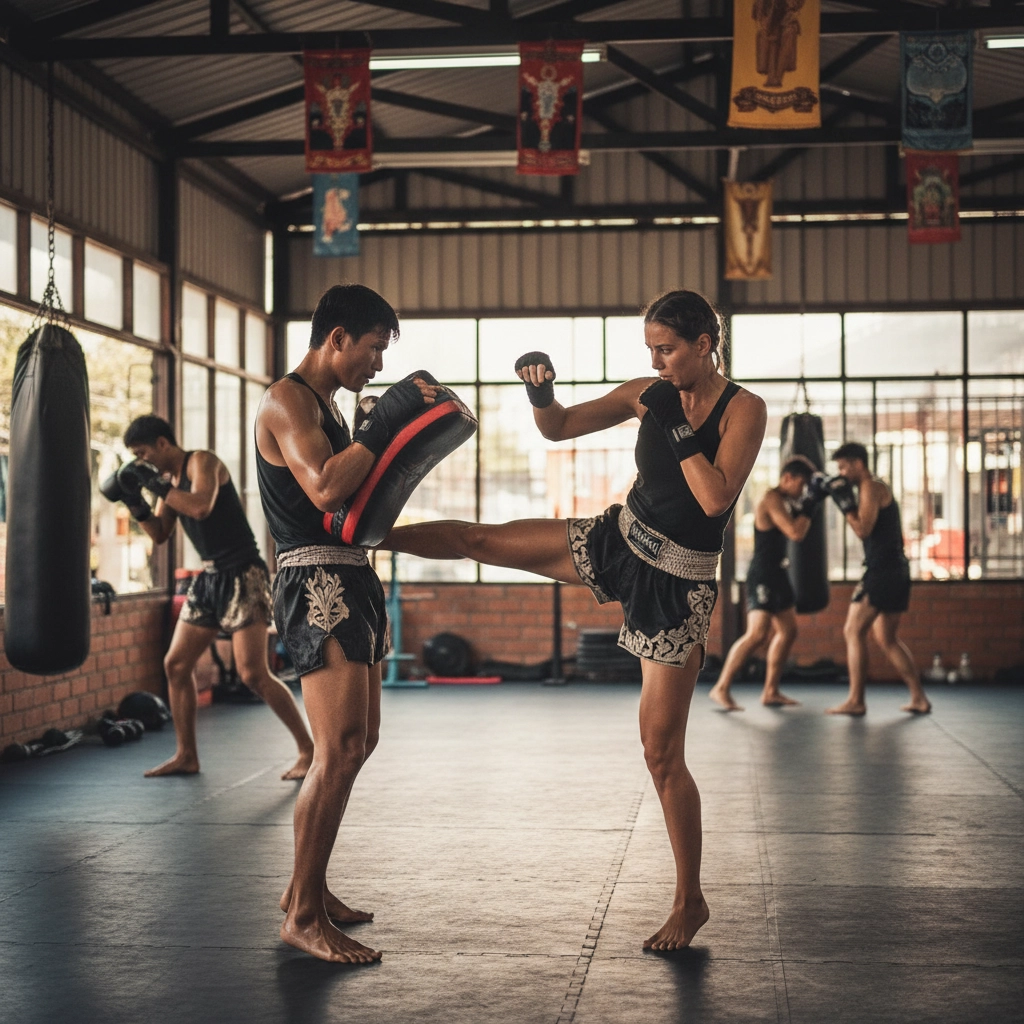
Why solid basics make your Muay Thai progress faster
You can’t shortcut skill: Muay Thai is built on simple, repeatable movements. When you lock in a reliable stance, guard, and basic striking mechanics, every drill, pad session, and sparring round becomes far more productive. Focusing on fundamentals early saves you from developing bad habits that slow progress and increase injury risk.
In this part you’ll stabilize your base and internalize the primary punches so you can generate power without wasted motion. Expect practical cues you can use immediately in drills and partner work.
Positioning first: stance, guard, and footwork cues
Your stance determines balance, mobility, and how effectively you transfer power. Use these simple rules every time you step on the mat:
- Feet width: Stand shoulder-width apart so you can move laterally and maintain balance when striking.
- Lead and rear foot: Keep the lead foot pointing slightly inward and the rear foot at a 45° angle to help pivot for power.
- Weight distribution: Keep about 50–60% weight on the rear leg to allow quick pushing and kicking while keeping the lead leg light for jabs and teeps.
- Hands high: Front hand at cheekbone level to jab and parry; rear hand by the chin to protect and load the cross.
- Chin tucked, eyes forward: Tuck your chin to your chest and keep eyes on your opponent — balance defense and vision.
Common corrections: don’t stand too tall (you become an easy target), and don’t cross your feet when moving (you lose balance). Practice stepping: small, controlled foot movements forward, backward, and lateral while keeping your guard up.
Basic punches you must master first
Focus on four core punches: the jab, cross, hook, and uppercut. These form the backbone of effective combinations and let you mix power with speed.
- Jab: The fastest strike — snap the lead hand straight out, rotate the shoulder slightly, and return to guard. Use the jab for range, setups, and disrupting rhythm.
- Cross: The power straight from the rear hand — push off the rear foot, rotate the hips and torso, and drive the shoulder forward while keeping your rear hand protectively near the chin.
- Hook: Short, bent-arm strike — rotate the lead hip and pivot the lead foot to create torque. Keep the elbow at roughly waist height for body hooks and higher for head hooks.
- Uppercut: Close-range vertical punch — bend the knees slightly, drop the weight, and explode upward through the legs and hips while keeping elbows tight.
Drill cues: shadowbox with emphasis on snapping the jab, then add the cross with hip rotation; pad work should prioritize clean mechanics over full power initially. Record a short clip of your drills to spot common issues like dropping the rear hand or telegraphing the cross.
Next, you’ll apply these fundamentals to simple combinations and introduce basic kicks and timing drills that speed up your striking development.

Simple combinations to build timing and flow
Now that your stance and core punches are reliable, layer them into short combinations that force you to link movement, rhythm, and defence. Start with three- to four-strike combos and repeat them until the transitions become automatic.
- Combo 1 — Jab, Cross, Step-Out: Jab to measure, cross for power, then immediately step off-line to avoid a counter. Cue: return hands to guard between strikes; the step should be small and decisive.
- Combo 2 — Jab, Cross, Lead Hook: Use the jab to set the target, drive the cross with the hips, and snap the hook with a short pivot of the lead foot. Cue: soft knees on the hook to load the hips and protect balance.
- Combo 3 — Jab, Teep, Cross: Jab to close the distance, teep to maintain range, then cross as the teep retracts. Cue: the teep is a range manager—not a long wind-up; drive through the ball of the foot and pull the hip back fast.
Practice progression: shadowbox the combo slowly, then on the pads at 60–70% power, finally with increasing speed. Record one round per combo and watch for habit weaknesses: dropped rear hand, telegraphed hook, or overcommitted weight on the front foot. Small corrections early save big technique fixes later.
Core kicks: teep, roundhouse, and low kick mechanics
Muay Thai kicks are shin-dominant and use the hips for power. Focus on three basics first — the teep (push kick), roundhouse, and low kick — and keep hitting fundamentals each rep: chamber, rotate, strike, and recover.
- Teep (push kick): Chamber the knee, drive the ball of the foot into the opponent’s torso or thigh, extend the hip, then retract quickly. Uses: distance control, disrupting rhythm, and setting up strikes. Common error: leaning back — keep your spine neutral and the rear hand up for protection.
- Roundhouse: Turn the hips fully, pivot the supporting foot, and strike with the lower shin. For rear roundhouse, load with a small step and whip the hips; for lead roundhouse, use a quicker snap. Cue: point the toes and follow-through with shoulder rotation.
- Low kick: Target the outer thigh with the lower shin, rotate the hip, and snap the kick through the target. Keep the non-kicking hand guarding and the kicking leg chambered to avoid telegraphing.
Drill these on the heavy bag and Thai pads: 3 sets of 10 reps each, focusing on consistent contact spot and foot pivot. On partners, start light—aim for controlled placement rather than maximum force until your balance and recovery are solid.
Timing drills and partner cues to speed up learning
Technique without timing is static. Add simple partner drills that force you to react, rhythmically strike, and maintain guard under pressure.
- One-touch mitt drill: Partner calls or points to a target; you respond with a single, crisp strike (jab, cross, or teep). Builds reaction and decision-making.
- Two-count sparring: Exchange only two planned strikes then reset (e.g., jab-cross, then back out). This teaches clean combinations and immediate recovery.
- Slow flow clinch entries: From a controlled range, practice stepping in with a jab then closing to a light clinch for three seconds—work posture and hand placement, not strength.
Time structure: 3–5 rounds of 2–3 minutes each with focused objectives (e.g., round 1: jab timing; round 2: teep entries). After each round, note one fixable detail to repeat in the next round. Repetition with intention is how you’ll fast-track usable Muay Thai skills.
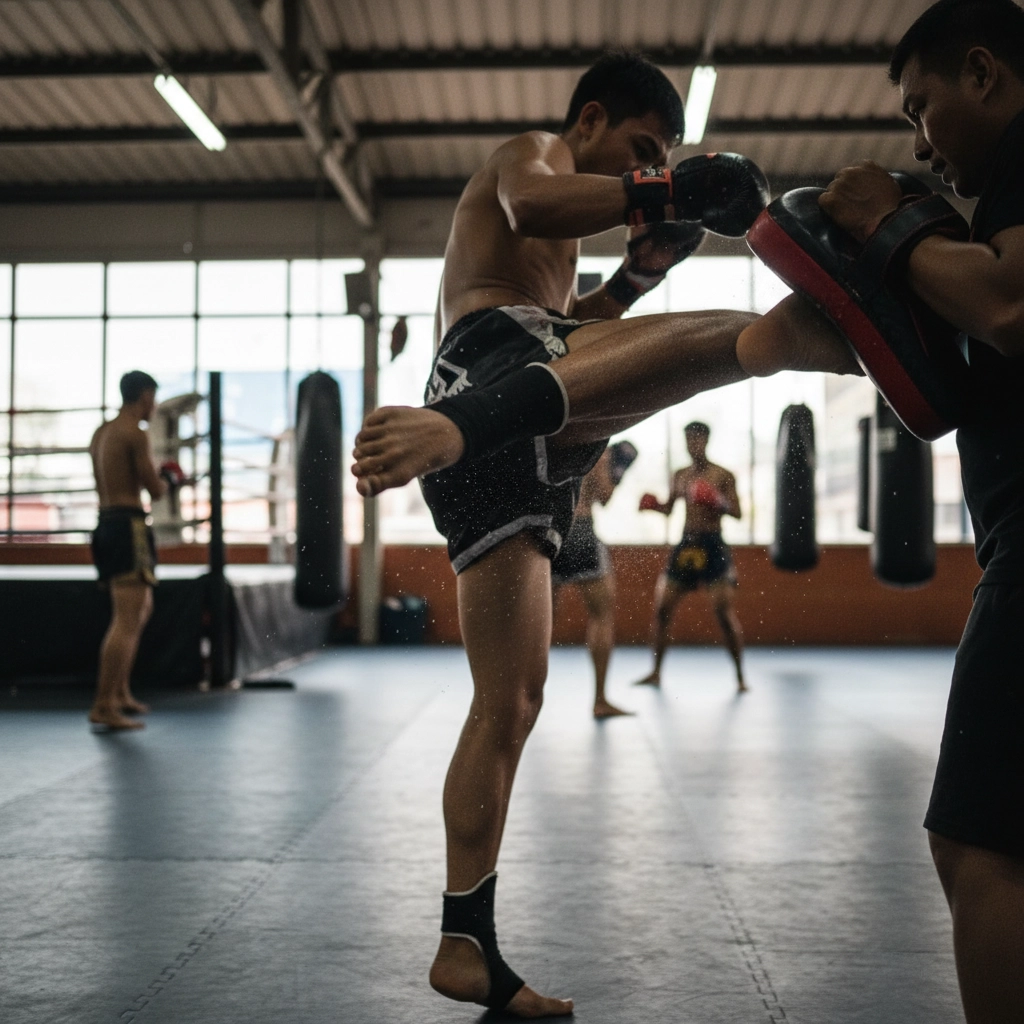
Build momentum: small habits that lead to big gains
Progress in Muay Thai comes from consistent, focused practice more than long sessions or flashy moves. Pick one or two technical details to polish each week, track them during short, intentional rounds, and ask a coach or training partner for targeted feedback. Use video to confirm what you feel matches what you do, and prioritize recovery so your reps stay high-quality rather than purely high-volume. When you keep the process simple and repeatable, improvements compound quickly.
- Schedule short, focused sessions (20–40 minutes) aimed at one technical goal.
- Record one drill per session and note one correction for the next training day.
- Seek coached feedback regularly and progress to controlled sparring only after basics are reliable.
For background reading and supplemental drills you can try at home, see Muay Thai basics.
Frequently Asked Questions
How often should a beginner practice the basic strikes to see improvement?
Aim for 2–4 focused training days per week combining technical drills (shadowboxing, pad work) with light conditioning. Even short, deliberate sessions—20–40 minutes—where you concentrate on one or two details will produce steady gains if you’re consistent. Rest and recovery on non-training days help maintain technique quality.
When is it safe to start light sparring and clinch work?
Start controlled, light-contact sparring once your coach confirms your stance, guard, and primary strikes are reliable under pressure. Before full sparring, practice structured drills like two-count exchanges, one-touch mitt drills, and slow clinch entries to build timing and posture. Progress intensity gradually under supervision.
What’s the quickest way to fix common issues like telegraphing punches or dropping the rear hand?
Use targeted drills: shadowbox slowly in front of a mirror to remove visible telegraphs, then drill the offending action at reduced speed on pads while focusing on hand return. Record partner drills to identify patterns, and practice dry repetitions emphasizing the corrective cue (e.g., “rear hand to chin”). Consistent, low-speed repetition builds the habit faster than rushing full-power reps.
Recommended Posts