
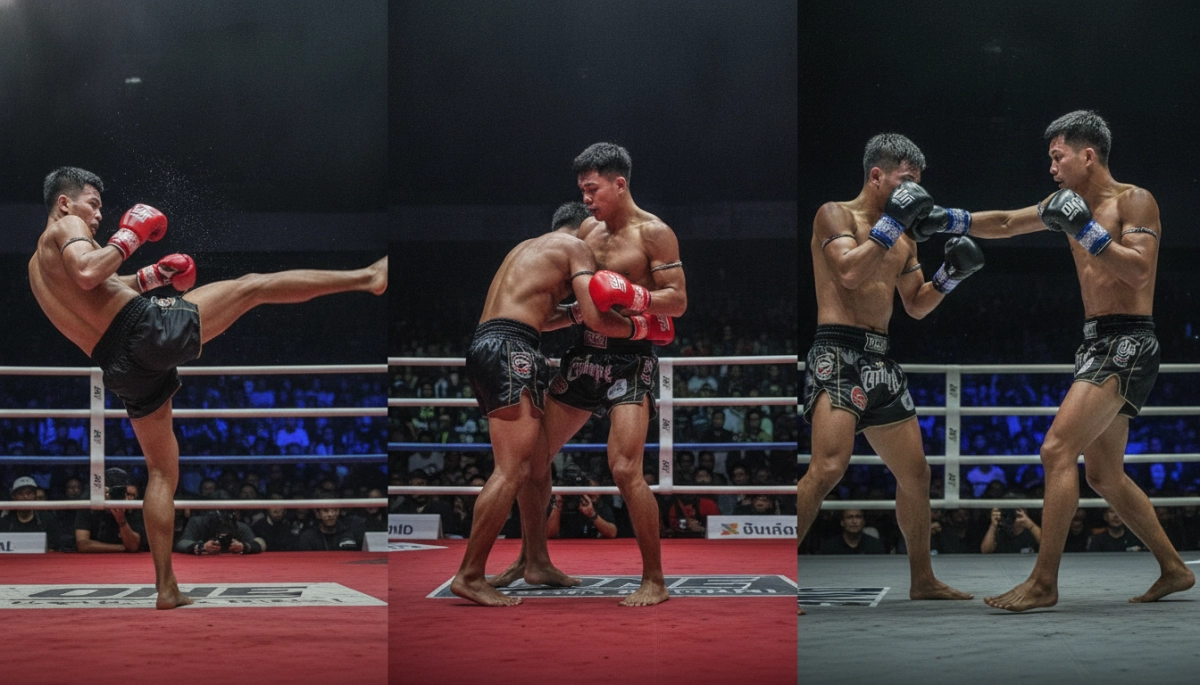
Why Nong-O is essential viewing if you study Muay Thai
You study fighters to learn patterns, timing, and decision-making; Nong-O is a prime example of textbook Muay Thai distilled into live action. Across top-tier stadiums and international promotions, he repeatedly demonstrates how precision, pacing, and technique trump raw power alone. When you watch his fights, you should look for how he sets traps, manages distance, and converts small positional advantages into scoring strikes and finishes.
What your eyes should track in each round
- Distance management: how Nong-O uses teeps and footwork to force opponent reactions.
- Timing and counters: the moments he punishes offensive overcommitments.
- Clinch entries and exits: subtle grips, posture control, and when he pivots to knees or sweeps.
- Energy distribution: how he allocates intensity across five rounds to control late-frame scoring.
Early career foundations that shaped his clinch and striking
To understand Nong-O’s current mastery, you need to see where the fundamentals came from. Early in his career he developed in the Thai stadium system where fights are frequent and technique must be repeatable under pressure. That environment teaches you to refine a small set of high-percentage tools — the same tools Nong-O uses today but executed with exceptional clarity.
Core clinch skills you can emulate
When you study his clinch work, focus on these repeatable elements that create control and scoring opportunities:
- Plum and off-center grips: he secures head control quickly while keeping an angle to avoid counters.
- Weight distribution: shifting his center to off-balance opponents before committing to knees or sweeps.
- Short-range striking: close elbows and short knees that score in tight spaces without large telegraphs.
- Seamless disengagements: recognizing when to break the clinch and restart striking at range.
Striking principles that often decide his fights
Your takeaway from Nong-O’s striking should be less about flashy moves and more about principles — precision over power, selectivity over volume. Watch how he chains a teep to disrupt rhythm, follows with a timing-based counter, and uses low kicks to handicap an opponent’s base before heavier strikes.
In the next section, you’ll get a fight-by-fight breakdown highlighting specific rounds where these clinch and striking principles changed outcomes, plus timestamped examples you can use for focused study.
Fight-by-fight breakdown: rounds and moments to study
Below are five representative fights (type-based, not exhaustive) that repeatedly surface when studying Nong-O’s textbook approach. For each, focus on the round and moment indicated — these are the high-yield clips where a single principle repeatedly changes outcomes.
– The teep-and-counter match (look mid-round 2): Nong-O opens with a patient teep rhythm to push his opponent off-line, then shortens distance as the opponent overreaches. Watch the sequence where the opponent reacts to a two-teep combo; Nong-O times a low-kick into a step-in cross. Study the foot placement on the step-in and the weight transfer from lead leg to rear, then rewind the teep rhythm that sets it up.
– The pressure-clincher rematch (final 90 seconds of round 3): In this type, Nong-O absorbs early pressure, secures a plum in the pocket and converts small postural changes into knees and short elbows. Focus on how he threads the off-center head control, subtly shifts his hips to create a sweep angle, then interrupts with an inside knee. Note how he never lets his posture go flat — hands stay active while hips move.
– The low-kick accumulation fight (rounds 2–4): When facing a stable, boxing-heavy opponent, Nong-O methodically attacks the lead leg to destabilize base before throwing heavier finishing strikes. Clip study: watch how he circles to the opponent’s front foot, plants a teep to create weight shifts, and follows with a targeted low kick to the same quadrant. The repetition is intentional; count the setups and see how the opponent’s stance degrades over two rounds.
– The southpaw countering example (opening minute of round 1): Nong-O often neutralizes southpaws by maintaining a straight-line teep and a rear-leg low kick that comes over the jab. Observe his head positioning off the centerline and the slight pivot that lets a rear leg low kick bypass the lead guard. This is a compact counter game—note the minimal telegraph and the quick reset to guard.
– The pacing and late-round control fight (last 2 minutes of round 5): For five-round fights, Nong-O’s greatest advantage is scoring while conserving energy. Study the way he shortens exchanges in rounds 4–5, favors single, high-quality strikes, and uses the clinch briefly to run the clock and rack up scoring knees without overcommitting.
For each clip, watch the sequence forward, then step it back frame-by-frame to isolate foot placement, hip angle, and grip changes. That micro-observation is where the lessons live.
How to turn each clip into focused drills
Watching is useful; applying is essential. Below are concise drills tied to the moments above so you practice the exact mechanics you observed.
– Teep-to-counter drill (partner or pad): 10 low-intensity teeps to the midsection from partner, immediately followed by a single step-in cross or low kick on the third teep. Emphasize timing over power and rehearse the step-in footpath slowly first.
– Clinch posture-and-sweep ladder: From plum position, practice three reps of shifting hips laterally, off-balancing the partner, and finishing with a knee. Start by holding posture for 10 seconds, then add dynamic off-balance and a sweep on the third rep.
– Leg-attack sequence (pad round): Three rounds of five-teep sets alternating with two low kicks to the same lead quadrant. Count how often the partner’s balance shifts. Increase power only after technical consistency.
– Southpaw angle shadowing: Shadowbox five 60-second rounds focusing on keeping the head off center, teep to the body, and a rear-leg low kick over an imaginary jab. Record and compare head angles.
– Late-round economy conditioning: Spar or flow-roll with a round-timer that forces you to execute a single, high-quality strike every 15 seconds, resetting posture between each exchange. This builds the decision-making and breath control Nong-O shows late.
Drill with intention: short, repetitive reps that mirror the clip’s exact timing will convert observation into dependable habit.
Before you close your video player or put the gloves away, pick one of the drill prescriptions above and dedicate three focused sessions to it this week. Repetition with attention to detail is the bridge between observing Nong-O and internalizing his timing, balance, and choices.
How to make Nong‑O’s lessons part of your toolkit
Turn study into habit with a simple loop: choose a clip, isolate one mechanic, drill it slowly, then test it live at reduced intensity. Prioritize quality over quantity — five clean repetitions that match the clip beat will teach far more than mindless volume.
Short practice checklist
- Pick one round or moment from the fight list above and note the exact seconds to review.
- Frame-step the clip to study footwork, hip angle, and grip. Write down two technical cues (e.g., “weight on lead when teep lands”).
- Drill those cues for three sessions: start slow, add tempo, then apply in light sparring or pad work.
- Record one session and compare to the original clip; adjust based on differences you observe.
- Repeat the loop with a new clip every two weeks to expand your toolkit incrementally.
For reference on Nong‑O’s career highlights and a central list of fights to pull clips from, see his profile: Nong‑O Gaiyanghadao (Wikipedia). Keep the process deliberate, and let the small technical gains compound — that’s where Nong‑O’s excellence lives.
Recommended Posts
