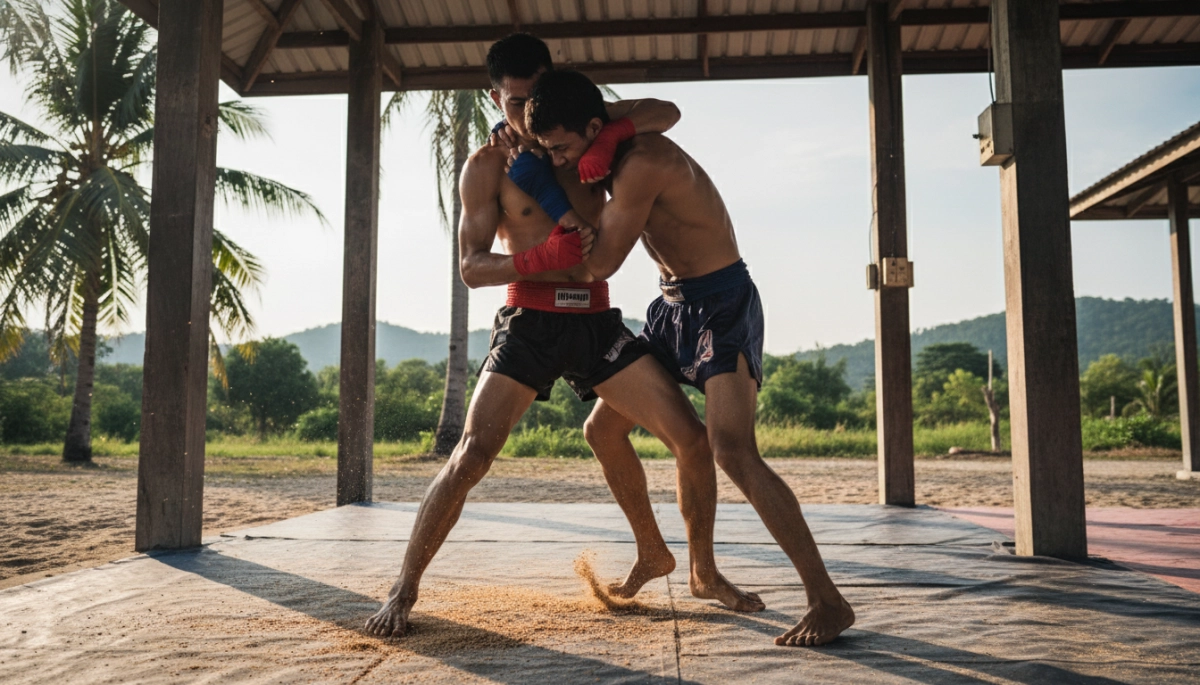
Why the Muay Thai Clinch Can Decide a Fight
The clinch is where fights change momentum. When you control the clinch, you control distance, knees, and the opponent’s center of gravity. Learning to dominate here gives you the ability to score points, sap your opponent’s energy, and create openings for throws and knees. As you read, focus on how small adjustments in grip, head position, and posture translate into decisive control.
What defining outcomes you should expect from effective clinch control
- Neutralizing an opponent’s punches and elbows by closing distance.
- Creating angles for knees and short-range strikes.
- Setting up off-balancing maneuvers that lead to sweeps and throws.
- Forcing the referee to separate or scoring sustained dominance during rounds.
Core Mechanics: Grips, Posture, and Line of Balance
Before attempting throws, you must build a stable platform. The clinch relies on three mechanical pillars: secure grips, dominant posture, and aggressive balance disruption. Training these repeatedly will make your throws more reliable under pressure.
Secure grips: the foundation of control
You’ll commonly use the double collar tie (plum) or the single collar/underhook combinations. A strong grip is not just about strength — it’s about placement and tension. Aim for:
- High collar ties with your biceps against the opponent’s jawline to control their head.
- Underhooks that sit deep under the armpit and contour to the ribcage to lift and manipulate the torso.
- Wrist and hand placement that lock the opponent’s arms without exposing your own balance to counters.
Posture and head placement to deny movement
Your posture should be compact and slightly forward-leaning, with your head driving into theirs. This reduces their ability to step away or explode with knees. Keep your chin tucked and your hips engaged so when you pull or push, the force travels through your whole body rather than just your arms.
Controlling the line of balance
Think in terms of lines: vertical (up/down), lateral (side/side), and rotational (twist). To throw effectively you must shift the opponent’s center of gravity off the vertical line. Use small, coordinated actions — a collar tie pull combined with a hip turn or a lifting underhook — to break their base. Foot placement matters: stay light on the balls of your feet, mirror their stance width, and step to angles that shorten their base.
Common mistakes to avoid include over-gripping with tired arms, allowing your head to be pulled down, and neglecting footwork. Drilling these fundamentals will make your transitions into sweeps and throws much smoother. In the next section you will learn specific clinch throws, step-by-step setups, and counters to common defenses.
Plum-to-Throw: The Basic Clinch Turn (Step-by-step)
The high double collar tie (plum) is not only for knees — it’s an ideal platform to execute a controlled turn-throw that resembles a hip toss when the opponent’s posture is compromised. Follow these steps to make it predictable and repeatable:
- Establish the plum: Get both hands high, biceps against the jawline, thumbs behind the neck. Pull their head down slightly to break their posture without over-committing your neck.
- Create the angle: Step one foot slightly outside their lead foot (if both orthodox, step your right foot to their outside right). This shortens their base and opens the lateral line.
- Load the hip: Drop your hips a bit and rotate them toward the outside step. Drive your head into theirs as you turn; this becomes the fulcrum for the throw.
- Lift and rotate: Use the collar ties to lift and pull the head forward while your hips and rear leg rotate and sweep slightly across their midline. Do not try to muscle them — the motion is a coordinated lift-turn, using hip torque to off-balance.
- Finish safely: Guide them down, keep chest-to-chest contact so you can continue control for follow-up knees or to disengage. Avoid sprawling backward; maintain forward pressure and step through as they fall.
Drill this slowly with a compliant partner, focusing on timing between the head pull and hip rotation. Once mechanics feel solid, increase resistance and practice finishing when the opponent resists the head pull by grabbing your arms or posting on the mat.
Underhook and Hip Sweep: Off-balancing for Low Throws
Deep underhooks are power tools for off-balancing. When you secure a single or double underhook, you can execute a lateral hip-sweep or foot trip that exploits the opponent’s compromised base.
- Entry: Pummel to get a deep underhook (elbow tucked under their armpit, palm facing up on their lat). Simultaneously control their near wrist with your free hand.
- Close the gap: Step your near foot between theirs, moving your lead shoulder into their chest to prevent them from creating space.
- Unweight and sweep: Pull with the underhook to lift and rotate their torso away from the sweeping leg. With your outside leg, sweep their far foot or hook behind the ankle and drive your hips through — the goal is to remove the base, not to lift them high.
- Options off the sweep: If the throw completes, move to follow-up knees, a body lock for a takedown, or a quick disengage to strike at a created angle.
Key cues: keep your elbow tight to compress their ribcage, use your shoulders and hips together, and sweep when their weight shifts to the targeted foot. Practice against partners who resist by sprawling or posting so you learn the timing to counter those defenses.
Common Clinch Defenses and How to Counter Them
Opponents will react predictably — pulling head down, pummeling for underhooks, posting hands, or stepping out. Anticipating and countering these makes your clinch offense effective.
- Defense: Head pull-down. Counter: Release one arm to underhook and elevate the opposite shoulder, creating space for knees; alternatively, transition to a body lock and drive to break posture further.
- Defense: Pummeling for underhooks. Counter: Use the whizzer (an overhook with downward pressure) to flatten their underhook, then circle to the side of the whizzer and execute a turn or trip.
- Defense: Posting or sprawling to avoid sweeps. Counter: Switch to higher control (plum), drive forward to compress and reestablish the sweep when they reset; or go to single-leg or kinked-body throws that exploit the posted arm.
- Defense: Stepping out to reset distance. Counter: Chain attacks — a quick knee or short elbow as they step followed by immediate reenforcement of the collar tie so you don’t lose position.
Train these counters in sequence drills: attack one throw, partner uses a specific defense, you respond with the counter, and repeat. This builds reflexive transitions so that when pressure rises in a real bout, your reactions are automatic rather than deliberative.
Drill Progressions and Safety
Take a methodical approach to drilling: begin slow, isolate one element (grip, head position, hip turn), and only increase speed as technique remains clean. Use progressive resistance partners so you learn timing against a moving target, and rehearse safe breakfalls and shoulder mechanics before full throws. Protect the neck and spine—avoid sudden, uncontrolled twists—and always communicate with your partner when increasing intensity.
- Start with static holds and positional sparring to feel grips and balance.
- Flow the plum-turn and underhook-sweep as a two-way drill, alternating roles.
- Introduce light-contact live clinch rounds, then scale up to full resistance.
- Practice defensive counters and safe disengagements to reduce injury risk.
Putting Clinch Mastery Into Practice
Mastering the clinch is a long-term endeavor that rewards patience, repetition, and smart training choices. Prioritize technical precision over brute force, layer drills into your weekly regimen, and test your skills in controlled sparring before relying on them in competition. For structured drill ideas and federation-level guidance, refer to IFMA training resources. Keep a training log, review footage of your clinch sessions, and continually refine the small details—grip placement, hip timing, and footwork—that turn good technique into dominance.
Key Takeaways
- Strong grips, compact posture, and active control of the opponent’s head are the pillars of effective clinch throws.
- Use progressive drilling—static to live—to build timing, balance disruption, and reliable finishes.
- Train counters and safety measures habitually so your clinch game remains effective under resistance and reduces injury risk.
Recommended Posts