
How modern drills accelerate your Muay Thai fundamentals
You train Muay Thai to become faster, cleaner, and more effective under pressure. Modern training drills prioritize transferable skills — precision, timing, footwork, and conditioning — rather than endless repetition of single techniques. By working with drills that mimic fight tempo and decision-making, you shorten the gap between practice and real application. In this part, you’ll explore core drills that set the foundation for more advanced combinations and live sparring.
Core movement and striking drills to build a reliable base
Start by refining the physical patterns that support every strike and defense. These drills emphasize balance, hip mechanics, and economy of motion so your power is consistent and sustainable through rounds.
-
Intentional shadowboxing (3–5 rounds)
Shadowbox with a specific focus each round: range control, hip rotation, or feint-to-strike. Move as if an opponent is present—adjust distance, visualize counters, and exaggerate weight transfer. Use slow, deliberate repetitions to engrain mechanics, then increase speed while maintaining structure.
-
Footwork ladder and angle work (2–4 minutes)
Use an agility ladder or imaginary rungs to practice in-and-out steps, lateral pivots, and diagonal entries. The goal is to create angles that open up clean striking lanes while minimizing exposure. Drill combos that end with a pivot to create immediate counter opportunities.
-
Heavy bag intervals with technical focus (6–8 rounds)
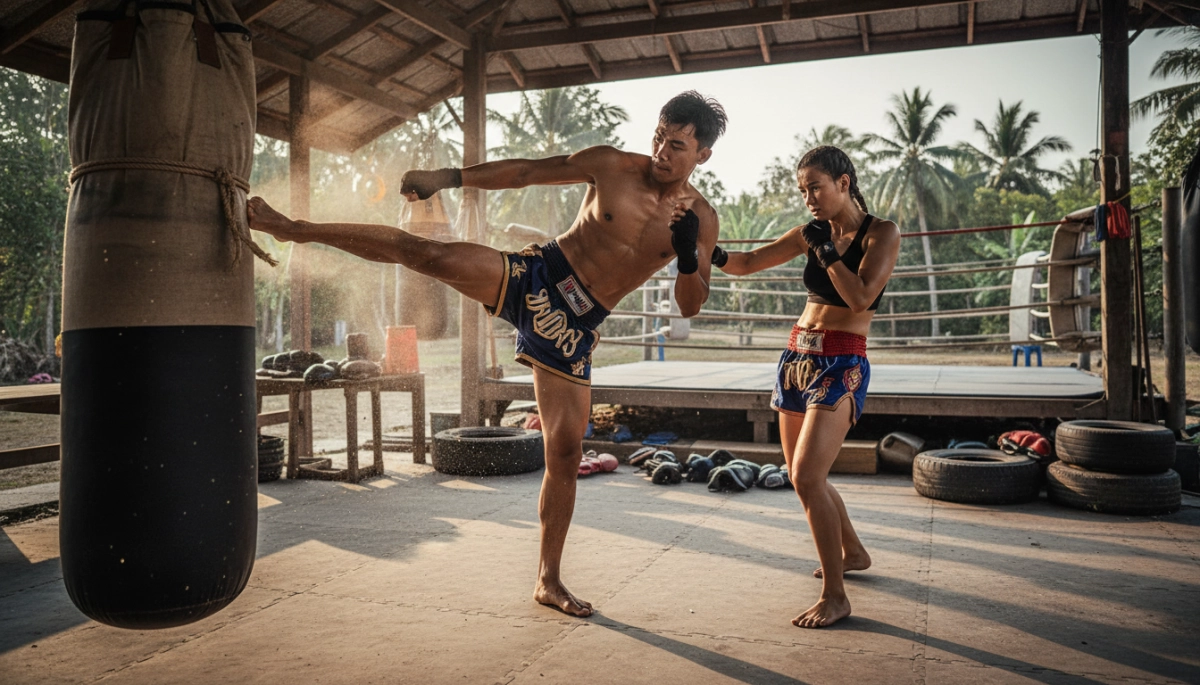
Instead of mindless punching, program short high-intensity intervals (20–40 seconds) where each round targets one technical goal: snap kick timing, elbow placement, or low-kick setups. Keep reps tactical—strike to a purpose, reset stance, then re-enter with variation.
Conditioning drills that transfer to sparring and clinch control
Conditioning in modern Muay Thai is functional: you condition systems that the sport demands rather than generic fatigue. These drills pair cardiovascular stress with technical tasks so you maintain skill under duress.
-
Tabata striking circuits
20 seconds on, 10 seconds rest for 8 rounds. Alternate explosive combinations with active recovery movements (e.g., hip bridges or light footwork). This trains anaerobic bursts and quick technical recovery.
-
Partner clinch flow (light resistance)
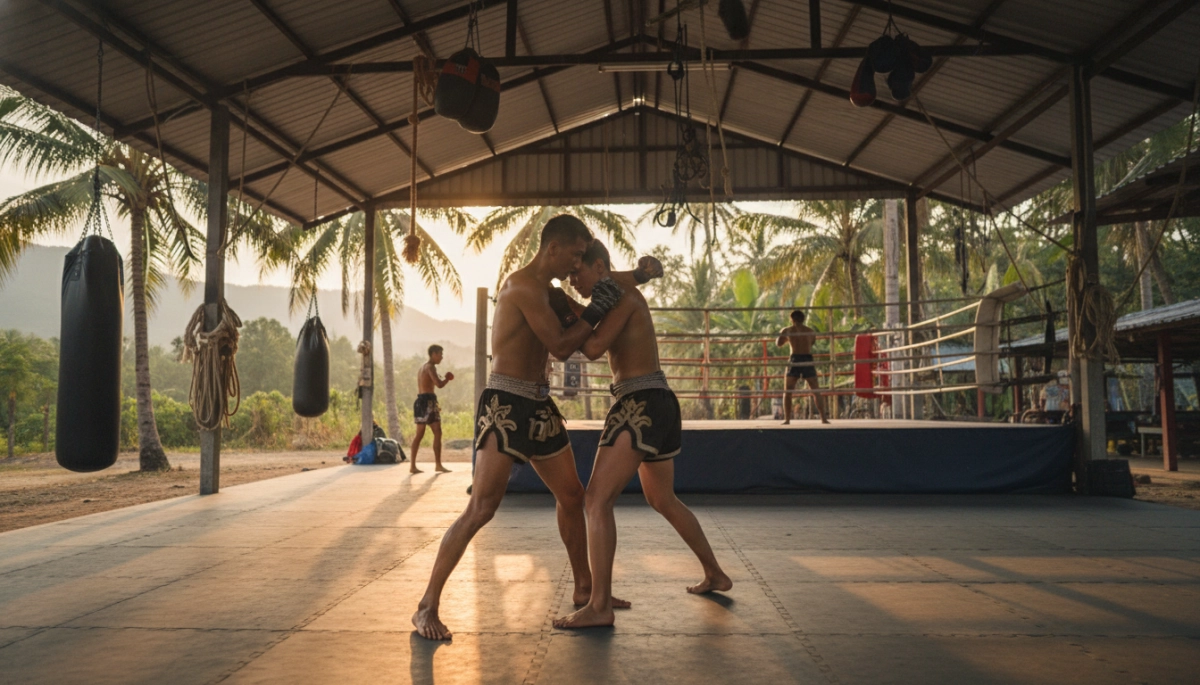
Work short 30–60 second rounds focusing on pummeling, base sinking, and off-balancing. The partner provides live reaction but keeps resistance cooperative so you can drill positional transitions and knee placement without a strength match.
These foundational drills create a reliable platform for more complex timing, sparring, and combination work. In the next section you’ll learn specific partner reaction drills and progressive combinations to sharpen timing and decision-making under pressure.
Partner reaction drills to sharpen timing and reading
Reactive ability — the split-second decision to counter, clinch, or exit — separates competent practitioners from fighters who dominate rounds. These partner drills force you to read cues, manage rhythm changes, and execute under realistic, variable input.
-
Tap-and-counter (3–5 minutes rounds)
Partner A uses light taps with the glove or shin to signal a strike (jab, teep, roundhouse), Partner B practices one clean counter: catch-and-return, slip-and-hook, or step-and-low-kick. The initiator varies timing and intensity randomly. Emphasize visual cues (shoulder dip, foot load), keep exchanges slow at first, then increase tempo.
-
Mirror-and-break (5–8 minutes)
Face-off with shared guard and mirror each other’s rhythm for 30–45 seconds—matching footwork, head movement, and faint pressure. On coach’s call or a verbal cue, one partner breaks with an offensive action while the other practices an immediate defensive response and counter. This builds anticipatory movement and economy of motion in transitions.
-
Reactive mitt rounds (4–6 rounds)
Pad holder randomly feeds single strikes or short sequences while the striker reacts with the most appropriate response (block, catch, counter). Keep rounds short and score reactions: 1 point for correct defensive choice, 2 points for an effective counter that creates space. Rotate roles so both partners practice reading and feeding realistic setups.
Progressive combination ladders to improve decision-making under pressure
Combos are more than rote sequences; they’re decision trees. Progressive ladders teach you how to branch choices mid-combination — when to commit, when to reset, when to switch levels — so your reactions remain tactical when cardio drops.
-
Branching 3–2–1 ladder (6–10 minutes)
Begin with a 3-strike base combination (e.g., jab-cross-teep). Partner or coach calls “2” to force a two-strike variation (jab-hook), or “1” to force a single finishing strike (low kick). Drill each branch until transitions are fluid. This conditions you to adapt mid-combo rather than sticking to rehearsed chains.
-
Level-change ladder (4 rounds)
Start standing combinations that flow into clinch or ground-freeze knee options. Example progression: jab-cross → check-step low kick → double elbow → clinch entry → one-knee exit. Practice each rung with light resistance, emphasizing the trigger that moves you between levels (distance, head position, guard drop).
-
Pressure-release intervals (EMOM style)
Every minute on the minute: 40 seconds of pressure combinations against a moving partner, followed by 20 seconds of a deliberate release (pivot out, teep away, or feint and back). This conditions both sustained offensive pressure and safe, strategic disengagement so you control tempo without burning out.
Controlled situational sparring and coach-led feedback loops
Take drills into semi-live scenarios where objectives are limited and feedback is immediate. Controlled sparring lets you test learned patterns without full-contact risk, and structured debriefs accelerate correction.
-
Objective rounds (3–5 minute rounds)
Assign each round a specific goal: “land two kicks to the lead leg,” “win the clinch twice,” or “counter every entry.” Keep intensity moderate and rotate partners. After each round, spend 60–90 seconds on targeted feedback: what worked, what telegraphed, and one actionable fix.
-
Coach freeze-and-correct (short rounds)
Coach stops the exchange at key moments to point out positioning, foot placement, or timing errors and immediately has the pair replay the sequence implementing the correction. This real-time correction embeds technical adjustments far faster than after-the-fact instruction.
Putting drills into consistent practice
Developing skill in Muay Thai is a long-game process: pick a handful of the drills above, rotate them into your weekly plan, and prioritize measurable, incremental progress over quick fixes. Keep sessions specific—define the technical or decision-making objective before you start each round—and use brief coach-led feedback to correct course immediately. Track simple metrics (success rate of counters, reaction times, number of effective clinch entries) so you know what to scale up and what to refine.
Stay mindful of recovery and injury prevention as you increase intensity. Modern drills are designed to be high-quality repetitions; if technique breaks down, back off the tempo and rebuild the movement with intent. For reliable resources on rules, safety, and international standards, consult IFMA resources.
Key Takeaways
- Use focused drills that mimic fight tempo to transfer skills to sparring and competition.
- Pair technical work with functional conditioning so skill remains intact under fatigue.
- Implement coach-led feedback and measurable goals to accelerate improvements safely.
Recommended Posts