
Why learning traditional Muay Thai basics gives you a solid fight and fitness foundation
When you start Muay Thai, you’re not just learning punches and kicks — you’re building a movement system that blends balance, timing, and power. Traditional Muay Thai emphasizes efficient body mechanics, simple but devastating strikes, and a practical approach to defense. As a beginner, focusing on fundamentals will help you move safely, progress faster, and reduce the risk of bad habits that become hard to break.
You’ll find that most advanced techniques are variations or combinations of basic elements. By mastering stance, footwork, and a handful of core strikes and blocks, you’ll create a toolbox that serves both fitness and sparring. The sections below walk you through how to position yourself, move, and deliver the essential strikes every Muay Thai beginner should learn first.
Establishing a reliable stance and footwork that you can always return to
Your stance is the foundation for balance, power generation, and quick defense. Spend time drilling a neutral, flexible stance before working on harder strikes. Focus on these adjustments and drills:
- Stance basics: Keep your feet shoulder-width, knees slightly bent, weight distributed about 60/40 toward your rear leg for balance and quick kicks. Hands stay up to protect your face — lead hand slightly forward and rear hand tucked to your cheek.
- Chamber and hip alignment: Rotate your hips slightly so your rear hip can drive punches and kicks. Keep your chin tucked and your eyes on your partner or bag.
- Footwork drills: Practice shuffle steps forward and back, lateral slides, and pivoting on the ball of the lead foot. Drill moving in and out of range while keeping your stance intact.
- Weight transfer practice: Throw light jab-cross combinations while exaggerating a small weight shift to understand how power flows from your feet through your hips to your strikes.
Drilling these elements slowly builds muscle memory. During pad work or bag sessions, always return to your stance between strikes to reset balance and prepare for the next attack or defense.
Core strikes to focus on first: form, not power
As you progress from stance and footwork, introduce these primary strikes; practise technique before trying to hit hard so you learn correct mechanics.
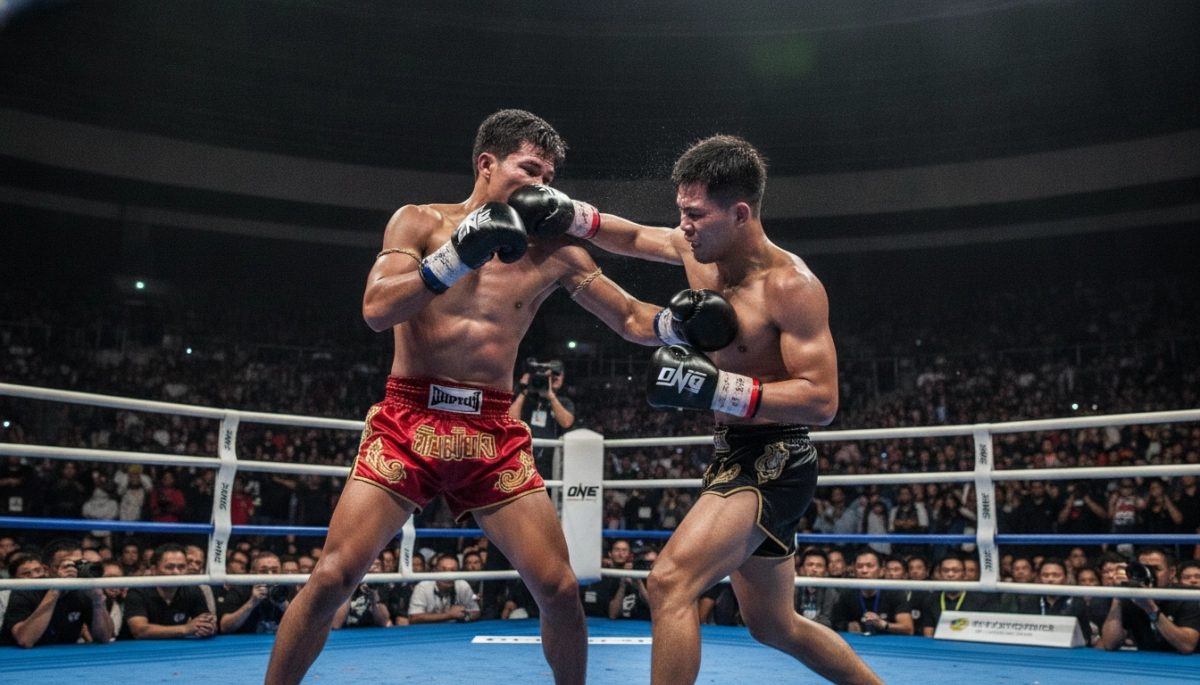
- Jab and cross: The jab controls distance; the rear cross uses hip rotation for power.
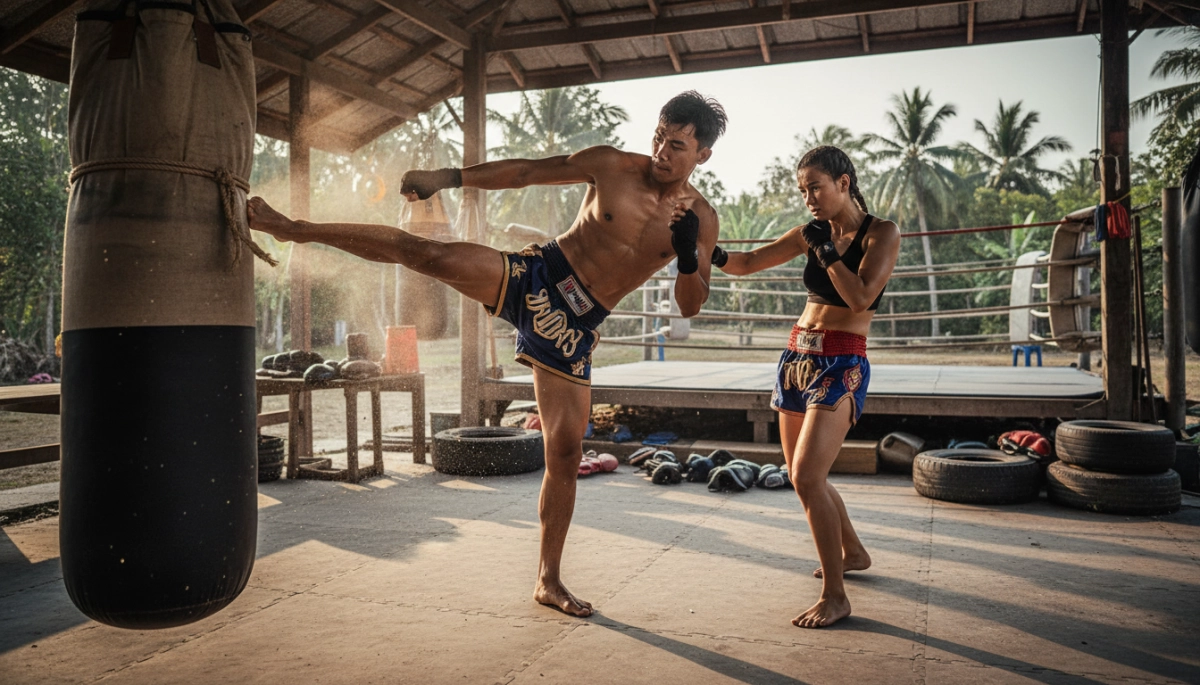
- Teep (front push kick): A fundamental space-management tool more than a power kick for beginners.
- Roundhouse kick: Learn the chamber, hip rotation, and contact surface (shin) to avoid injury.
- Basic knees and elbows: Start with straight knees from the clinch range and short, controlled elbow drills to understand angles.
- Defensive basics: Parry, check kicks with your shin, and use shoulder roll or block-and-counter drills to build defensive instincts.
Practice these strikes in slow, deliberate repetitions and on pads or a heavy bag under coach supervision. Proper repetition will let you progress from technique to power safely.
Next, you’ll move into paired drills and simple combinations that connect these stance, footwork, and basic strikes into usable patterns for sparring and self-defense.
Paired drills and simple combinations to turn technique into timing
Once you’ve built a stable stance and learned the core strikes, paired drills are where those isolated movements begin to connect. The goal isn’t to win yet — it’s to develop timing, distance sense, and the habit of resetting to your stance. Start slow, add rhythm, then increase speed and power as control improves. Try these structured progressions:
- 1-2-teep drill: Partner holds pads for a light jab-cross on cue, then steps in for a controlled teep. Drill with a consistent rhythm — 30 seconds at technical speed, 30 seconds faster, then one round for power. Focus on balance and returning to stance after the teep.
- Check-and-counter: Attacker throws a low kick (light), defender practices a shin check then immediately counters with a cross or low kick. Start by pausing after the check to place the counter, then remove the pause to build flow.
- Jab to roundhouse progression: Jab to set distance, rear cross to create rotation, then chamber and throw a controlled roundhouse. Drill the sequence slowly to sync hip rotation and foot pivot before increasing speed.
- Pad-hold communication: Have the pad holder call “touch” (light), “snap” (faster), or “power” (full speed) to teach pace control and situational awareness.
Rotate roles often so both partners practice attack and defense. Use rounds of fixed time (2–3 minutes) with short rests to mimic class structure. Record one technical point each round — for example, “lead hand up on kick” — to keep drills focused rather than repetitive.
Intro to the clinch: safe entries, basic control, and beginner knees
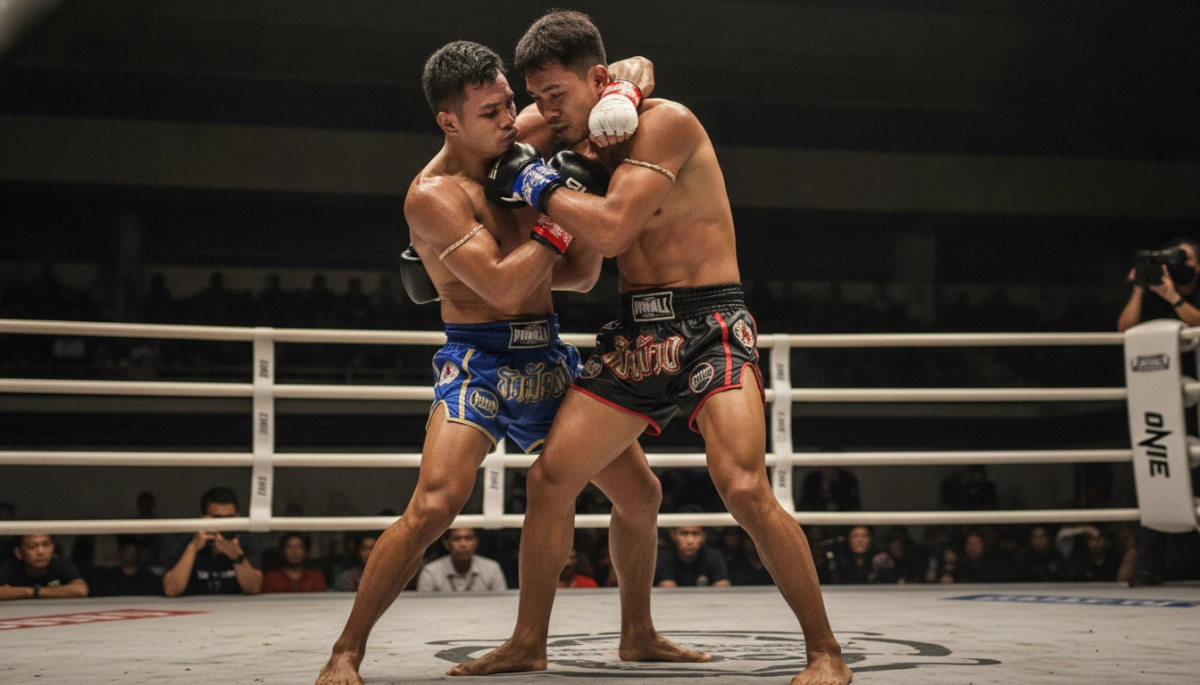
The clinch is a core element of traditional Muay Thai that often intimidates beginners. Start with the simplest, safest elements: a reliable entry, pummelling for inside control, and straight knees. Keep contact cooperative and under coach supervision.
- Safe clinch entry: Close the distance with a jab-cross or teep to disguise forward movement. Slide a hand high to the back of your partner’s head while the other controls the near-side arm — don’t overcommit until you’ve secured grip and posture.
- Pummelling basics: Practice alternating inside-control pummels to gain the dominant forearm position. Do short, timed exchanges (30–60 seconds) emphasizing posture and balance rather than force.
- Simple knee mechanics: From a stable clinch, drive a straight knee into the midsection using a slight step and hip push. Start with snap knees (quick, controlled) before trying heavy driving knees. Keep elbows tight to avoid exposing your ribs.
- Breaks and escapes: Learn the basic break — frame on the partner’s hips, step back, and reestablish range. Practise exits calmly so you can transition to striking or reset stance.
Clinching is about position and timing more than brute strength. Work short rounds, prioritize technique, and communicate with your partner to keep drills productive and safe.
How to structure a beginner session for steady progress
A consistent session template helps you practice variety without losing focus. Here’s a practical outline you can use in class or on your own:
- Warm-up (10–15 min): Joint mobility, dynamic stretches, light shadowboxing to reinforce stance and footwork.
- Technique rounds (15–20 min): Slow repetition of 2–3 core strikes or combinations with a partner or shadowboxing. Emphasize form over power.
- Drill/pad work (15–20 min): Paired drills from above and coached pad rounds focusing on timing and accuracy.
- Clinch or light sparring (10–15 min): Controlled clinch work or situational sparring with clear rules and a coach present.
- Conditioning and cool down (10–15 min): Core work, mobility, and stretching to aid recovery.
Train consistently (2–4 sessions/week for beginners), track one technical goal per week, and allow rest days for recovery. Small, focused improvements compound quickly — steady practice beats sporadic intensity every time.
Moving forward with your training
Keep your focus on steady, measurable progress: pick one technical goal for each session, train with intention, and prioritize safety over showy power. Seek feedback from a qualified coach, use controlled partner drills to build timing, and introduce sparring or harder contact only when your fundamentals are solid. Track small wins (clean pivot, consistent teep, controlled clinch) and give yourself recovery time so improvement compounds rather than stalls.
If you want reliable information on rules, events, and finding certified gyms or coaches, consult established organizations such as the IFMA. Watching traditional fights and technical breakdowns can also sharpen your sense for rhythm and practical application, but always test new ideas slowly under supervision.
Key Takeaways
- Master a neutral stance and slow, repetitive drills to build safe, efficient mechanics before adding power.
- Use paired drills and short, focused clinch practice to connect technique with timing and control.
- Train consistently, prioritize coaching and recovery, and introduce higher-intensity work gradually.
Recommended Posts