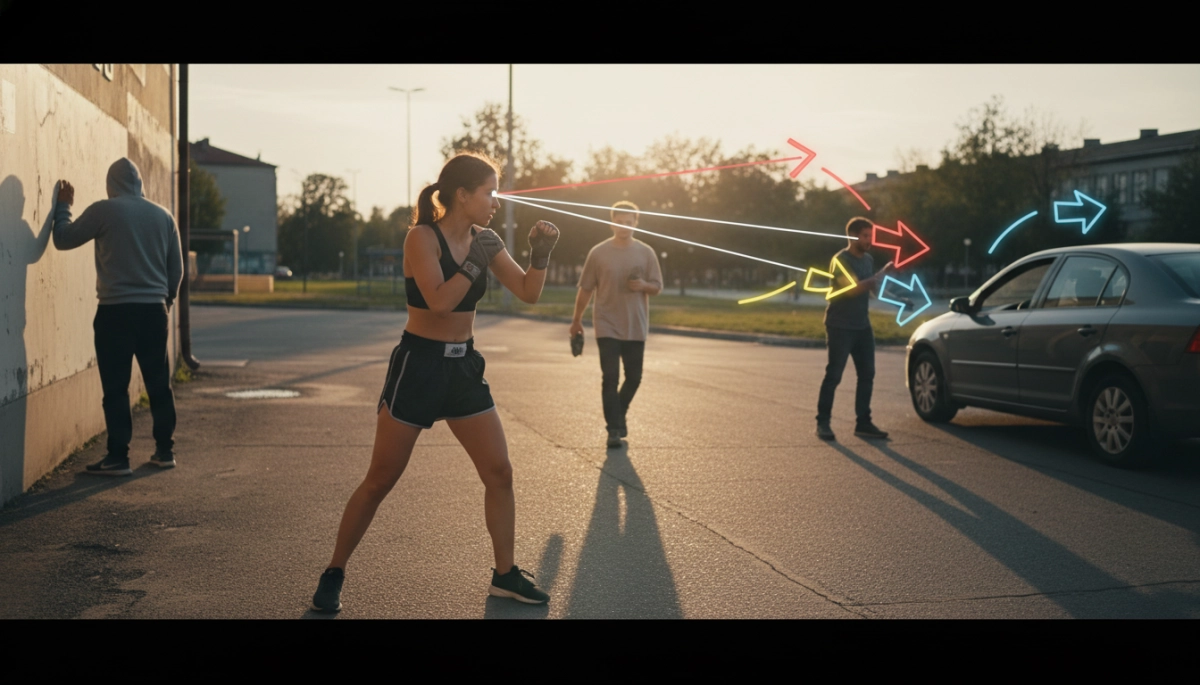

How Muay Thai clinch and strikes give you real-world control
When you face a sudden threat, you rarely get a perfect distance or a calm environment. Muay Thai’s clinch is designed for messy, close-range exchanges where control, balance, and short, powerful strikes win the moment. In self-defense, you don’t need perfect technique or ring conditioning—you need tools that reliably stop aggression, create space, and allow you to escape. This section explains why the clinch is practical for self-defense and how simple strike choices amplify its effectiveness.
Why clinch control matters more than flashy techniques
In a street scenario, you’ll often be grabbed, shoved, or forced into close quarters. The clinch gives you ways to:
- control your attacker’s posture so they can’t generate powerful strikes
- create openings for knees and elbows that end confrontations quickly
- off-balance or turn an opponent to make an escape easier
- protect vital targets (head and torso) while you apply offense or disengage
For self-defense, prioritize simple, high-percentage actions: secure head control, stabilize your base, deliver a short knee or elbow, then disengage. These steps minimize time in danger while maximizing control.
Fundamentals of clinch posture, grips, and safety you must practice
Before you drill combinations, establish a reliable clinch platform. Good fundamentals reduce the risk of being thrown, tripped, or struck effectively by an assailant.
Key elements of an effective self-defense clinch
- Head position: Keep your forehead or hand on the attacker’s jawline or neck to control their head. Controlling the head controls the body.
- Grip type: Use double overhooks, a single collar-and-elbow, or a rear head-and-arm hold depending on how the aggressor is positioned. Focus on pressure, not fancy holds.
- Base and footwork: Maintain a staggered stance with knees slightly bent. Your weight should be low and centered so you can absorb pushes and deliver knees.
- Safety first: Protect your chin and ribs. If the attacker is larger, aim to create leverage rather than force. Small adjustments—angle shifts and steps—are more effective than brute strength.
Short strikes from clinch that are practical and repeatable
From a secure clinch, you want to use short-range strikes that require minimal setup and deliver maximum effect. The primary options are straight knees to the body or thigh, short horizontal elbows to the temple or cheek, and quick foot stomps to disrupt balance. Each should be practiced for economy of motion so you can strike cleanly and return to control or exit.
With these fundamentals in place—understanding why the clinch matters, how to establish safe control, and which short strikes are reliable—you’re ready to learn specific clinch-to-strike combinations and drills that build speed, timing, and decision-making. In the next section you’ll get step-by-step combos and partner drills to practice them safely.
High-percentage clinch-to-strike combos (step-by-step)
Below are three simple, repeatable combos designed for self-defense. Each emphasizes control first, a short decisive strike, and an immediate option to disengage. Practice slowly until the mechanics are reflexive—speed comes after accuracy.
Combo A — Collar control + short knee + push-off
- 1. Establish a collar-and-elbow grip (one hand on the neck or jawline, the other controlling the opponent’s elbow).
- 2. Pull the head down slightly to bend their spine and create space for a short, vertical knee to the midsection (aim for the stomach or floating ribs).
- 3. Immediately follow the knee with a quick outward step and a firm two-handed push to the sternum/shoulders to break distance.
- Why it works: the head control makes the knee more powerful and the push-off creates a clear escape window.
Combo B — Overhook control + elbow to temple + off-balance sweep
- 1. Secure a double overhook (both arms over the attacker’s arms) and pull their head forward to compromise posture.
- 2. Short, horizontal elbow to the temple or cheek—compact and driven by your torso rotation, not arm reach.
- 3. Step to the outside, twist their hips with your knee or foot to off-balance them, then release and move to safety.
- Why it works: the overhooks limit their punching ability, the elbow is fast and disorienting, and the off-balance step reduces the chance of a follow-up attack.
Combo C — Rear head-and-arm + short stomp + reverse knee
- 1. From slightly behind or to the side, secure a rear head-and-arm (one hand behind the head, the other controlling the far elbow).
- 2. Stomp the nearest foot sharply to disrupt their base and attention.
- 3. Drive a short reverse knee (hip-driven) into the lower ribs or solar plexus, then disengage by spinning away or stepping back.
- Why it works: the head control keeps them square, the stomp forces a weight shift, and the reverse knee amplifies the effect without long telegraphing.
Partner drills to build timing, control, and safe exits
Drill these combos with a partner in controlled progressions. Start at low intensity and increase only when both practitioners can perform clean technical repetitions.
- Timing drill: Partner holds a static clinch grip. Performer executes Combo A slowly, pausing at each step. Repeat 8–10 times each side. Focus: head control and compact knee mechanics.
- Resistance progression: Partner applies light push/pull resistance. Performer must keep clinch control while delivering the chosen combo and creating space to disengage. Increase resistance gradually.
- Reaction drill: Partner tries common counters (attempts to pry hands, raise elbows, step around). Performer practices immediate corrective actions—re-secure grip, re-angle, or finish the strike—then exits. Run 2–3 minute rounds.
- Safety rules: use mouthguards, controlled impact on elbows/knees, and set a clear tap/out signal. If training stomps or sweeps, use gloves/shin guards and limit power.
Practical escapes and responses to common clinch reactions
After striking, your priority is creating distance and a route to safety. Recognize three frequent attacker reactions and respond simply:
- If they cover up: Push off the sternum, pivot to the side, and move away. If necessary, use a quick palm strike to the chin to break the cover, then exit.
- If they try to pry your hands: Transition to the opposite grip (double overhooks or rear head-and-arm), step offline, and deliver a compact knee before pushing away.
- If they attempt a takedown or trip: Lower your center briefly, widen your base and step toward their lead leg to nullify leverage; then disengage once you’ve regained posture.
Train these responses until the sequence—control, strike, create space, leave—is instinctive. In real encounters, decisive, simple actions executed with good posture and awareness are far more effective than elaborate techniques.
Putting it into practice: mindset, safety, and responsibility
Clinch work and short-range strikes are tools—how you use them matters as much as what you do. Approach training with a mindset focused on control, restraint, and escape rather than domination. That keeps your reactions simple and lawful in high-stress moments.
Prioritize safety for yourself and your training partners. Drill slowly, add resistance gradually, and rehearse exits as often as strikes. Real-world effectiveness comes from repetition under pressure, not from memorizing complex sequences. Include scenario-based practice and stress inoculation so your motor patterns hold up when your heart rate rises.
Finally, accept that training never stops. Seek qualified instruction, review legal considerations for self-defense in your area, and keep fitness, balance, and awareness part of your routine. If you want a quick primer or reference on the art and rules, see Muay Thai basics.
Key Takeaways
- Clinch control + short, compact strikes create high-probability options: control, strike, create space, and exit.
- Train progressively with partners—focus on posture, simple mechanics, and safe exits rather than flashy moves.
- Prioritize legal, ethical use and ongoing coaching; practice situational awareness and stress-adapted reps.