Why Muay Thai translates to practical self-defense and what you should expect
You train Muay Thai for more than sport; you develop timing, distance management, and striking efficiency that are directly applicable in threatening situations. In a self-defense context, your goal shifts from scoring points to creating space, escaping danger, or disabling an aggressor long enough to flee. This requires you to blend basic Muay Thai techniques with acute situational awareness and a hierarchy of strikes tailored to survival rather than competition.
What situational awareness means in everyday settings
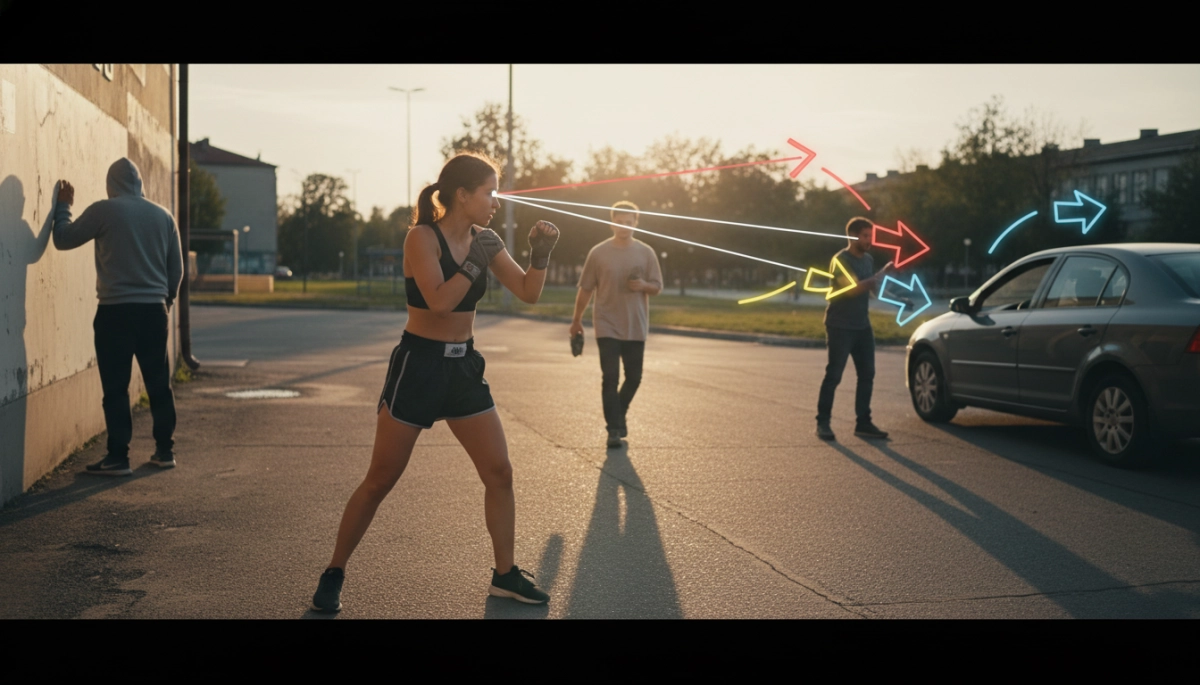
Situational awareness is the habit of perceiving, understanding, and anticipating events around you. As a Muay Thai practitioner, you already apply elements of this concept—reading an opponent’s posture, noticing weight shifts, and timing counters. In public spaces, you extend those same skills to notice environmental cues and human behavior that signal risk.
- Perceive: Keep your head up, scan exits, and note how people move or cluster.
- Interpret: Ask whether a person’s behavior is unusual—for example, excessive pacing, aggressive verbal tone, or repeated glances.
- Act: Choose a safe action—reposition, create distance, call for help, or prepare to use force if escape is impossible.
Immediate pre-engagement checks and mental priorities
Before you consider striking, you must run a quick mental checklist. This reduces hesitation and ensures your response is proportional and effective. Your first priorities are safety, legal considerations, and the quickest route to escape. Muay Thai gives you tools, but your decision framework determines how you use them.
A simple pre-engagement checklist to rehearse
- Assess threat level: Is the person verbally aggressive, reaching for a weapon, or attempting to close distance?
- Identify escape paths: Are there clear exits, crowds, or obstacles that help or hinder your movement?
- Call for help: Use your voice to attract attention or summon assistance when possible—noise often deters attackers.
- Keep legal proportion: Respond only with the force necessary to stop the threat and get away.
How your Muay Thai stance and guard change for self-defense
In a fight-for-fun you may adopt a forward, aggressive stance. For self-defense, prioritize mobility and protection. Lower your center slightly, keep hands high to protect the head, and maintain a slight sideways angle to minimize target area. Use your footwork to create angles for escape rather than to pursue a prolonged exchange. Practicing these stance adjustments will make your strikes quicker and your retreats safer.
With these awareness habits and mental priorities drilled into your reflexes, you’re ready to look at which strikes you should prioritize in common self-defense scenarios and why they work — the next section breaks down those strike priorities and simple combinations you can rely on under stress.
Strike priorities: what to hit first and why
In self-defense your strikes should do one or more of the following: disrupt the attacker’s balance or senses, create space, or immediately disable a critical function long enough to flee. That changes which techniques you reach for compared with the ring. Prioritize simple, high-probability strikes that you can execute under stress.
- Open-hand strikes (palm-heel): Fast, accurate, and less likely to cut your hand than a closed-fist punch. Aim for the nose, chin, or jaw to cause pain, disorientation, and reflexive backward movement.
- Push kick (teep): Excellent for creating space. Target the hips, solar plexus, or torso to shove an aggressor off-balance and open an escape route. It’s low-risk and keeps you out of clinch range.
- Low-line leg strikes: Lead-leg teeps to the knee, or controlled low kicks to the thigh, disrupt mobility and buy time. A well-placed low kick can slow pursuit without requiring knockout power.
- Elbows in close quarters: Short, compact, and devastating at close range. Aim to the face, jaw, or temple when the attacker closes distance. Elbows are effective in confined spaces where kicks and big punches are impractical.
- Knees from the clinch: Use short, driving knees to the groin, hips, or thighs if an attacker is within clinch range. They’re simple to apply and painfully effective for disengagement.
- Target priority: disruption before destruction: Eyes, nose, throat, and knees are priority targets for disruption. You don’t need to “finish” someone—only to create the opening to escape.
Simple, stress-tested combinations you can rely on
Under adrenaline your fine-motor skills shrink. Build a small toolbox of 3–5 combinations that are mechanically simple and versatile. Drill them until they become gross-motor responses.
- Combo A — Assert, disrupt, exit: Loud verbal command + palm-heel to nose/chin + push kick to the chest/hip + step back to a safe angle. Purpose: immediate disruption and creation of distance.
- Combo B — Close-quarters break: Short elbow to jaw + clinch knee to thigh/groin + turn-and-shove (break) to escape. Purpose: break out of grab or close clinch and move toward an exit.
- Combo C — Mobility stopper: Jab or palm to face + low kick to lead thigh + push kick to hips as they stumble. Purpose: slow forward momentum so you can retreat or reach a crowd.
Keep each sequence to two or three strikes. The goal is not a prolonged fight but a decisive, repeatable pattern that creates time and space.
Drills and training focus to make these skills reliable
Train under conditions that mimic stress and sensory overload. That will ensure your brain chooses the right, simple response when it matters.
- Repetition on heavy bag: Practice the combinations at realistic power and footwork. Emphasize breathing out on impact and immediate repositioning.
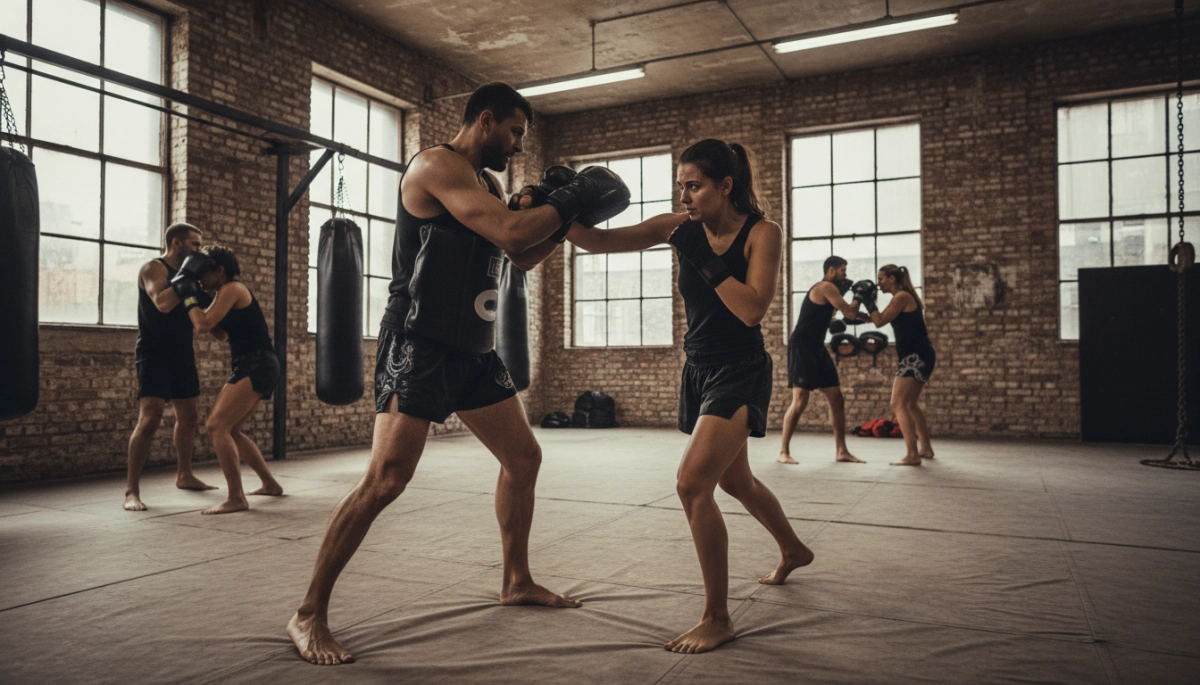
- Partner drills with controlled resistance: One partner simulates a grab or rush; the other practices the escape combination. Gradually increase speed and unpredictability.
- Scenario and movement drills: Practice exiting down a hallway, through a doorway, or around obstacles while applying a strike sequence. Add bystanders or noise to improve focus.
- Adrenaline management: Include high-intensity intervals before drills so you learn to execute under elevated heart rate—practice clear vocal commands, quick strikes, and immediate escape.
Train these priorities and drills consistently. In the moment, speed and decisiveness matter more than technical perfection—practice so those responses become instinctive.
Putting readiness into practice
Training for self-defense is as much about mindset and preparation as it is about technique. Keep rehearsing your simple strike sequences, situational checks, and escape routes until they feel like default responses. Prioritize de-escalation and escape over confrontation; use force only as a last resort and only to the degree necessary to reach safety. Maintain basic first-aid knowledge and check the legal boundaries for self-defense in your area—reliable information is available from resources like the Legal Information Institute.
Seek qualified instruction and practice scenario-based drills with partners who can simulate realistic resistance safely. Regular, focused practice under stress will build the decisive, protective reflexes you need. Above all, carry the responsibility that comes with training: protect yourself, avoid unnecessary harm, and use your skills to get to safety.
Key Takeaways
- Situational awareness—perceive, interpret, act—should be your first line of defense.
- Prioritize simple, high-probability strikes (palm-heel, teep, low kicks, elbows, knees) to disrupt and create an exit.
- Drill under realistic stress, practice escape-first strategies, and stay informed about legal and medical responsibilities.